
Best Chinese AI Model in 2026: DeepSeek, Qwen, Kimi, GLM, and MiniMax Compared

By Olivia Hart
MyClaw Editorial
MyClaw
Run Best-in-Class AI Agents Now
Run OpenClaw or Hermes Agent on managed MyClaw hosting, so your AI agent stays online, updated, and ready for real work.
AI Takeaway
- Best overall: There is no single best Chinese AI model for every job. DeepSeek, Qwen, Kimi, GLM, and MiniMax each stand out in different situations.
- Best free options: DeepSeek, Kimi, Qwen Chat, Doubao, and Ernie are the easiest places to try first, though "free" can mean a chatbot, open weights, or a low-cost API.
- Best for coding: Qwen3-Coder, Kimi K2, GLM, and DeepSeek are the most useful names to compare for repo work, tool use, and agent workflows.
- Best for business use: Look beyond benchmarks. Hosting, data policy, context length, tool reliability, and model switching matter just as much as raw model quality.
Quick Picks: Best Chinese AI Models by Use Case
Start with the job, not the leaderboard. A model that feels great in a chat window may not be the best model for long documents, coding agents, APIs, or private deployment.
| Use case | Strong picks | Why they fit |
|---|---|---|
| Free AI chatbot | DeepSeek, Kimi, Qwen, Doubao | Easy to try for writing, translation, summaries, and everyday questions |
| Coding agent | Qwen3-Coder, Kimi K2, GLM, DeepSeek | Better for repo work, tool calls, debugging, and multi-step tasks |
| Low-cost API | DeepSeek, Qwen, MiniMax | Competitive pricing and accessible developer options |
| Long context | Kimi, DeepSeek, GLM, MiniMax | Useful for codebases, reports, logs, papers, and large source sets |
| Multimodal work | MiniMax, Qwen, Hunyuan, Kling | Stronger when image, video, audio, or creative workflows matter |
What Counts as a Chinese AI Model?
A Chinese AI model can mean a consumer chatbot, an open-weight model, or a hosted API.
Chatbots, Open Weights, and APIs
Chatbots such as DeepSeek, Kimi, Doubao, Ernie, and Qwen Chat are the fastest way to test answer style, speed, language fluency, and formatting.
Open-weight models give developers more control. Depending on the license, they can be downloaded, modified, hosted privately, or routed through third-party providers. The tradeoff is infrastructure work.
APIs sit in the middle. You do not manage the model yourself, but you can connect it to products, scripts, internal tools, and agents.
Why Chinese AI Models Became So Competitive
Chinese AI models became competitive because several things happened at once: lower cost, fast releases, stronger open-model ecosystems, and real demand from daily work.
DeepSeek changed expectations around affordable reasoning. Qwen built a wide open ecosystem. Kimi became known for long context. GLM gained attention for agentic coding. MiniMax pushed on multimodal workflows.
The result is practical: these models can now help with code review, research, extraction, summaries, inbox triage, browser automation, and recurring workflows.
The Best Chinese AI Models to Know in 2026
DeepSeek: Best for Low-Cost Reasoning and APIs
DeepSeek is often the first model to evaluate because it proved that a Chinese AI model could be capable and unusually cost-efficient. It is a strong starting point for reasoning, coding help, extraction, and low-cost API work.
The main caution is practical: check who hosts the model, where data is processed, and whether your workflow can switch models later.
Qwen: Best for Open-Weight Builders and Coding Agents
 Qwen is Alibaba's model family, and its strength is breadth. It covers chat, coding, multilingual work, multimodal tasks, open-weight deployment, and agent-style use cases. Qwen3-Coder is especially relevant for repositories, tool calls, and multi-step code changes.
If you are comparing Qwen with other models for agent work, the recent Gemini 3 Flash vs Qwen 3.5 breakdown looks at speed, cost, coding, and workflow fit.
Kimi: Best for Long Context and Research
 Kimi, from Moonshot AI, is strong for long documents, source-heavy writing, research briefs, and codebases where the model needs to keep more information in view.
Kimi K2 also made the family more relevant for coding and agentic tasks, especially when the work involves preserving context and comparing sources.
GLM: Best for Long-Horizon Coding Work
GLM is the model family from Z.AI, formerly known internationally as Zhipu AI. Its most interesting angle is long-horizon coding with tool use, iteration, and feedback loops.
For a closer comparison of two agent-oriented Chinese models, see Kimi K2.6 vs GLM-5.1, especially for coding, reasoning, benchmarks, and OpenClaw-style workflows.
MiniMax, Doubao, Ernie, Hunyuan, and Kling
MiniMax belongs in the conversation when the task includes multimodal input, long context, coding, and production-style agent runs. Doubao and Ernie are easy consumer options. Hunyuan and Kling are more relevant for video, image, and media generation.
Best Free Chinese AI Options
"Free" can mean free to chat with, free to download, or cheap enough for daily use. Separate those categories before choosing.
Free Chat Apps
If you want no setup, start with DeepSeek, Kimi, Qwen Chat, Doubao, or Ernie. They are useful for questions, Chinese-language writing, translation, summaries, and quick code help.
Try the same prompt across two or three tools and compare detail, uncertainty, formatting, and follow-up answers.
Open-Weight Models
Open-weight models can be free to access, but not free to operate. Someone still pays for GPUs, servers, maintenance, monitoring, and security.
That tradeoff is worth it when you need control, customization, privacy boundaries, or model independence.
Low-Cost APIs
Low-cost APIs are often the most realistic choice. They let you build with DeepSeek, Qwen, MiniMax, GLM, Kimi, or other models without hosting them yourself.
Do not choose only by token price. Failed tasks, weak JSON, bad tool calls, poor long-context behavior, or slow responses can cost more in cleanup time.
How to Choose the Right Chinese AI Model
Match the Model to the Task
Use a simple decision path:
- Coding and repo work: Qwen3-Coder, Kimi K2, GLM, DeepSeek.
- Long documents and research: Kimi, DeepSeek, GLM, MiniMax.
- Everyday free chat: DeepSeek, Kimi, Doubao, Qwen.
- Multimodal creation: MiniMax, Qwen, Hunyuan, Kling.
- Cost-aware API work: DeepSeek, Qwen, MiniMax.
The best model for a one-off chat may not be the best model for an agent that has to run tools, inspect files, and recover from errors.
Check the Workflow Details
Before you commit to a model, check the details that affect real work:
- Context window: Can it handle your codebase, docs, or logs?
- Tool calls: Can it use tools reliably?
- Output limits: Can it produce long reports or patches?
- Structured output: Can it return JSON, tables, or schemas?
- Latency: Is it fast enough for the task?
- Fallbacks: Can you switch models if quality, pricing, or access changes?
For coding-heavy workflows, the Coding Agents use case shows how an always-on workspace can handle PR review, tests, debugging, and repo maintenance. The coding-agent skill shows how model choice connects to execution.
Check Data, Hosting, and Compliance
Chinese AI models can be excellent, but business use needs a clear deployment choice. Ask where data is processed, who hosts the endpoint, what the license allows, and whether the workflow can switch models.
For sensitive work, a trusted cloud or private deployment is very different from sending raw data to a public chatbot.
Turn a Chinese AI Model Into an Always-On Agent
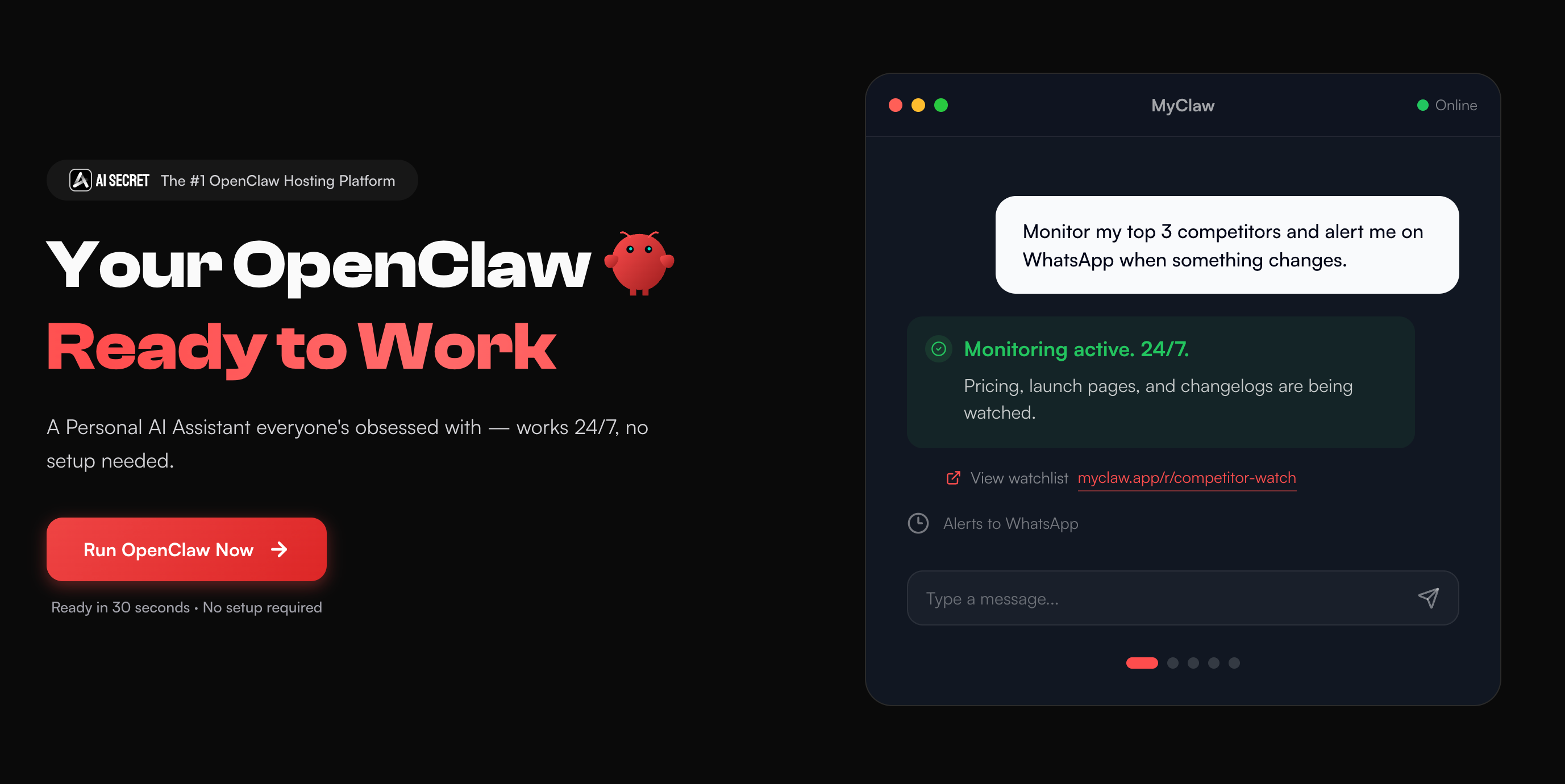 Choosing the model is only half the job. The bigger gain comes when the model can use tools, remember context, run on schedule, and deliver finished work. That is where MyClaw fits naturally: it gives you a hosted OpenClaw or Hermes Agent workspace so the model can work inside a running agent.
Step 1: Pick One Job
Choose a specific starting point: code review, inbox triage, competitor tracking, research summaries, or weekly reporting. Then pick the model that fits that job.
Step 2: Connect the Tools It Needs
An agent becomes useful when it can reach the places where work happens: Gmail, Google Docs, Sheets, Slack, GitHub, Notion, browser sessions, files, APIs, and scheduled jobs.
Step 3: Review the First Runs
Start small and review the first few outputs. Once the agent is reliable, let it handle repetitive gathering, checking, and first drafts.
Chinese AI Models vs ChatGPT, Claude, and Gemini
Chinese AI models are often cheaper, more open, and increasingly strong at coding and agent tasks. They still do not replace ChatGPT, Claude, or Gemini in every setting.
Use Chinese models when you want lower costs, open-model flexibility, coding experiments, long-context research, or model routing. Use ChatGPT, Claude, or Gemini when you need mature support, a specific compliance posture, or a model your team already depends on.
The most practical stack may use both: routine extraction can go to a cheaper model, harder reasoning can go to a stronger model, and a backup can stay ready.
Which Chinese AI Model Should You Try First?
The best Chinese AI model is not one universal winner. DeepSeek is strong for low-cost reasoning and API work. Qwen is excellent for open-weight builders and coding agents. Kimi is compelling for long context and research. GLM is one to watch for long-horizon coding. MiniMax matters for multimodal work.
If you only need a free chatbot, try two or three and see which one fits your prompts. If you are building a product or workflow, compare APIs, context windows, tool calling, data handling, and fallback options. If you want the model to do more than answer questions, think about the runtime around it: tools, memory, schedules, review steps, and model switching.
Skip the Setup, Run Best-in-Class AI Agents Now
Launch a managed OpenClaw or Hermes Agent workspace in minutes, with always-on hosting, updates, and support handled by MyClaw.