Best Claude Fable 5 Alternative for Coding, Agents, and Long-Running Work

By Alex Morgan
MyClaw Editorial
MyClaw
Run Best-in-Class AI Agents Now
Run OpenClaw or Hermes Agent on managed MyClaw hosting, so your AI agent stays online, updated, and ready for real work.
AI Takeaway
- Best default alternative: GPT-5.5 is the easiest starting point for coding, research, tool use, and everyday agent work.
- Best Claude-native path: Claude Opus or Sonnet makes sense if you want to stay close to Claude workflows while Fable 5 access is uncertain.
- Best long-context option: Gemini 3.1 Pro is worth testing for large documents, multimodal work, and Google-connected workflows.
- Best practical strategy: Do not build everything around one model. Route tasks by cost, sensitivity, and difficulty.
- Best agent setup: If your work needs files, browser access, terminal loops, memory, and scheduled execution, MyClaw is a practical hosted OpenClaw alternative to rebuilding an agent stack around one model.
Claude Fable 5 Alternatives at a Glance
Claude Fable 5 was announced on June 9, 2026 as Anthropic's generally available Mythos-class model for long-horizon coding, knowledge work, vision, research, and autonomous agents. Three days later, Anthropic posted an update saying access to Fable 5 and Mythos 5 was suspended while it worked to restore availability.
So the question is practical: what should you use if you planned to build around Fable 5, or if Claude Fable 5 is unavailable in the product surface you rely on?
| Alternative | Best For | Main Tradeoff |
|---|---|---|
| GPT-5.5 | Everyday coding, tools, research, and cost-aware agent work | May need escalation for very hard tasks |
| Gemini 3.1 Pro | Long context, multimodal work, and Google Workspace workflows | Workflow quality matters as much as context size |
| Claude Opus or Sonnet | Claude-native writing, review, reasoning, and continuity | May not fully replace Fable 5's long-horizon autonomy |
| Kimi, Qwen, DeepSeek, GLM | Cost-aware coding and fallback routing | Needs hands-on evaluation |
| MyClaw (hosted OpenClaw) | Persistent agents with tools, files, browser, and model routing | Replaces the agent runtime layer, not the model API |
If you just need a strong model, start with GPT-5.5 or Gemini. If you need a Claude-like workflow or a Claude Code alternative, test Opus or Sonnet first. If you need long-running agent work, consider MyClaw as the alternative at the workspace layer: the model can change while the agent environment stays intact.
Why Replacing Fable 5 Is Not Just a Model Choice
 Fable 5 stands out because it was built for work that stretches across many steps: codebase migrations, research loops, visual reasoning, file-based memory, and tasks where the model has to recover after mistakes.
That makes replacement harder than picking the next smartest chatbot. A cheaper model may answer individual prompts well, but still struggle when the job requires tools, state, file edits, and repeated validation.
Access and Policy Matter
Availability comes first. If a model can disappear from your workflow, the workflow needs a fallback. This matters for coding agents, research pipelines, and internal automation. The same logic applies if you need a Claude Mythos 5 alternative, because Fable and Mythos share the same access uncertainty around this launch window.
Data handling is just as important. Anthropic's Mythos-class policy requires prompt and output retention for safety monitoring. For casual tasks, that may be fine. For proprietary source code, customer messages, legal files, financial analysis, or unreleased research, it becomes a policy question.
Consistency also matters. Fable 5's safeguards can route certain requests to Claude Opus 4.8. That is better than a hard refusal, but it still means the model behind the workflow can change.
Compare Finished Work, Not Demos
A real workflow shows whether the model can inspect the right files, choose the right tool, patch an error, run checks, and stop when the work is actually done.
For coding, compare the whole loop: repo understanding, file edits, tests, failure recovery, and a clear summary of what changed.
For a deeper model-by-model comparison, the existing Claude Fable 5 vs GPT-5.5 breakdown is a useful next step.
The Best Alternatives by Use Case
There is no universal winner. The right replacement depends on whether the task is routine, long-running, sensitive, or tied to Claude-specific tooling.
GPT-5.5 for Everyday Agent Work
 GPT-5.5 is the easiest default for most work: coding help, research, documents, spreadsheets, tool use, summaries, and ordinary automation. It is capable enough for many production tasks without forcing every run through a premium long-horizon model.
Use it first for bug fixes, test generation, research drafts, document cleanup, technical plans, and common tool loops. If the real question is the best AI model for long horizon coding, escalate only when the task needs more autonomy than a default model can provide.
Gemini 3.1 Pro for Long Context and Multimodal Work
 Gemini 3.1 Pro is a strong candidate when the task includes long documents, screenshots, charts, PDFs, or Google Workspace context.
Long context alone is not enough. A huge window does not guarantee that the model will notice the right paragraph, choose the right file, or ignore stale context. Test retrieval quality, source handling, and tool behavior before moving serious work over.
Claude Opus or Sonnet for Claude-Native Continuity
 If your workflow already lives inside Claude or Claude Code-style habits, Claude Opus or Sonnet may be the least disruptive option. They are familiar, strong at writing and reasoning, and useful for code review, refactoring, and careful analysis.
They may not replace Fable 5's most ambitious long-running behavior, but they can cover a lot of practical work while Fable access is unclear. For a closer Claude-family comparison, see Claude Fable 5 vs Opus 4.8.
Kimi, Qwen, DeepSeek, and GLM for Cost Control
 Open and semi-open model ecosystems are useful when you care about cost, deployment flexibility, or avoiding dependence on a single frontier provider. They can be excellent for routine subtasks, parallel experiments, and fallback routing.
The tradeoff is evaluation work. Check repo editing, long-context behavior, and tool following before relying on any one model.
Use Routing Instead of Picking One Permanent Winner
The strongest replacement strategy is usually not a single model. It is a routing plan.
Use a cost-balanced model for routine work. Escalate difficult long-horizon tasks to the strongest available model. Send sensitive work only to providers and settings that match your policy. Use a second model for final review when mistakes would be expensive.
| Task Type | Good Starting Point |
|---|---|
| Routine coding and research | GPT-5.5 |
| Long documents and multimodal analysis | Gemini 3.1 Pro |
| Claude-native review and writing | Opus or Sonnet |
| Low-cost repeated subtasks | Kimi, Qwen, DeepSeek, or GLM |
| Final high-stakes review | Stronger premium model or second-model reviewer |
This is where agent workflows become different from chat. A stable coding agent workflow makes it easier to compare models without rebuilding files, permissions, logs, and tests each time.
For important decisions, a second-model review can also help. A skill like Oracle fits that pattern: one model does the work, another challenges the assumptions before you accept the result.
Keep the Workspace Stable When the Model Changes
If you only use a model API, switching models means rewriting prompts, reconnecting tools, and rebuilding habits. For simple tasks, that is fine. For agents, it becomes friction.
A persistent agent needs more than intelligence. It needs files, browser access, terminal execution, connected apps, memory, schedules, logs, and a way to report back. If those stay stable, the model can change without the entire workflow falling apart.
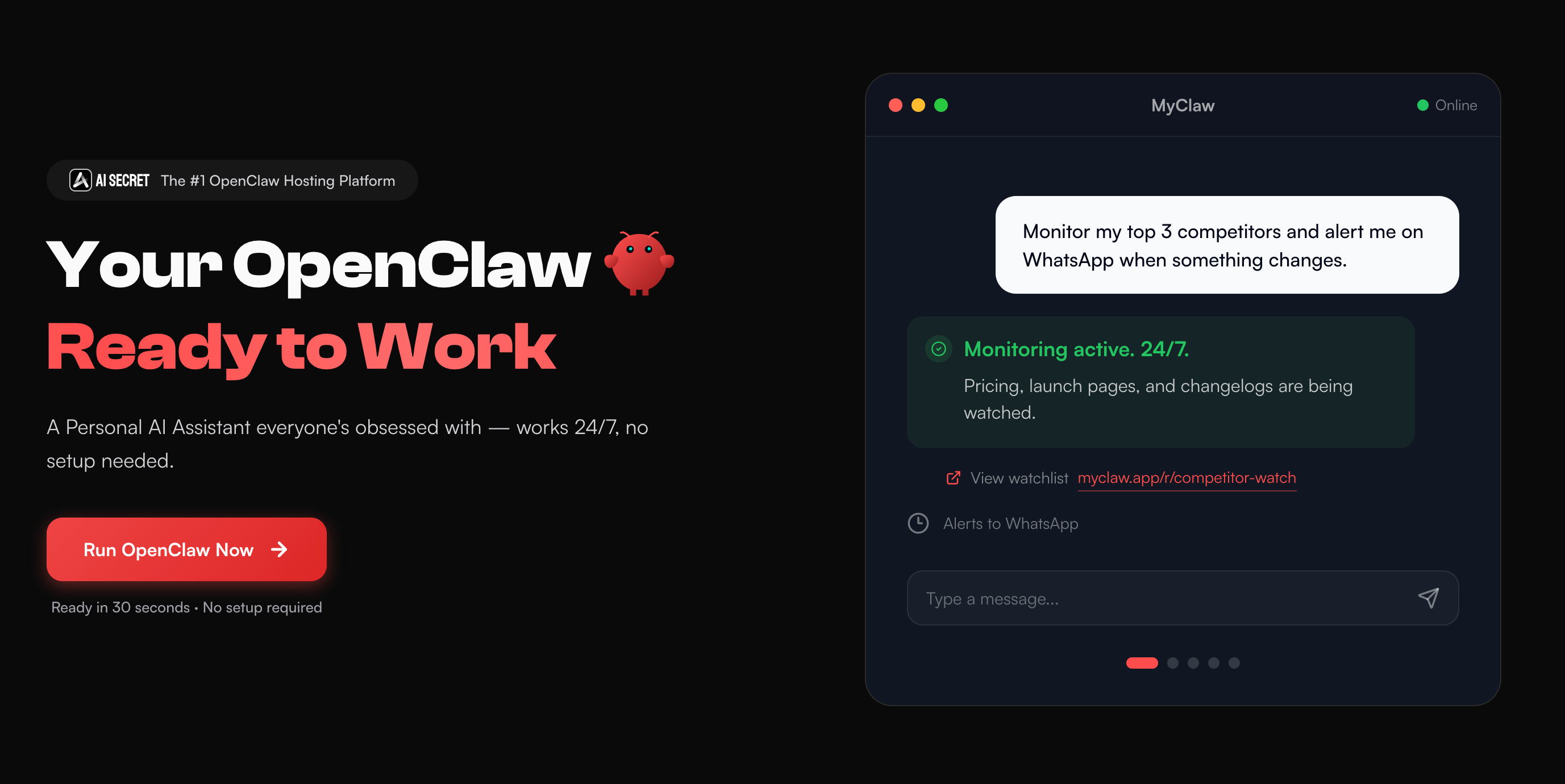 This is where MyClaw becomes a practical Claude Fable 5 alternative for agent workflows. It does not replace Fable 5 as a model; it gives you a model agnostic AI agent workspace that replaces the fragile setup around the model. MyClaw hosts private OpenClaw workspaces that stay online while you test and route different model providers, so the agent keeps the same tools, files, browser, memory, and scheduled routines.
This matters for PR review, weekly research briefs, SEO monitoring, support triage, spreadsheet reporting, and browser tasks that need to run on a schedule. If one model becomes unavailable or too expensive, the agent should still have somewhere to run.
How to Choose Your Replacement
Start with the job, not the leaderboard.
Choose GPT-5.5 if you want the fastest practical replacement for everyday coding and tool use. Choose Gemini 3.1 Pro if the work is long-context or multimodal. Choose Claude Opus or Sonnet if continuity with Claude matters. Test Kimi, Qwen, DeepSeek, or GLM if cost and fallback depth matter. Choose MyClaw or another hosted agent workspace if the work needs to keep running after your laptop closes.
Before changing your workflow, test one repo task, one document-heavy research task, and one browser or app automation task. Give each candidate the same budget and permissions, then track completion rate, retries, human edits, time, and cost. The winner is the setup that finishes reliably.
Conclusion
The best Claude Fable 5 alternative depends on the kind of work you need to finish. GPT-5.5 is the easiest model default, Gemini 3.1 Pro is strong for long-context and multimodal work, Claude Opus or Sonnet can preserve Claude-native workflows, and MyClaw is a practical alternative when the real need is a hosted agent workspace rather than another model endpoint.
The bigger lesson is simple: serious agent work should not depend on one model staying available forever. Keep the workspace stable, route tasks by difficulty and policy, and test alternatives on real work. That approach is more durable than replacing one frontier model with another and hoping nothing changes.
Skip the Setup, Run Best-in-Class AI Agents Now
Launch a managed OpenClaw or Hermes Agent workspace in minutes, with always-on hosting, updates, and support handled by MyClaw.