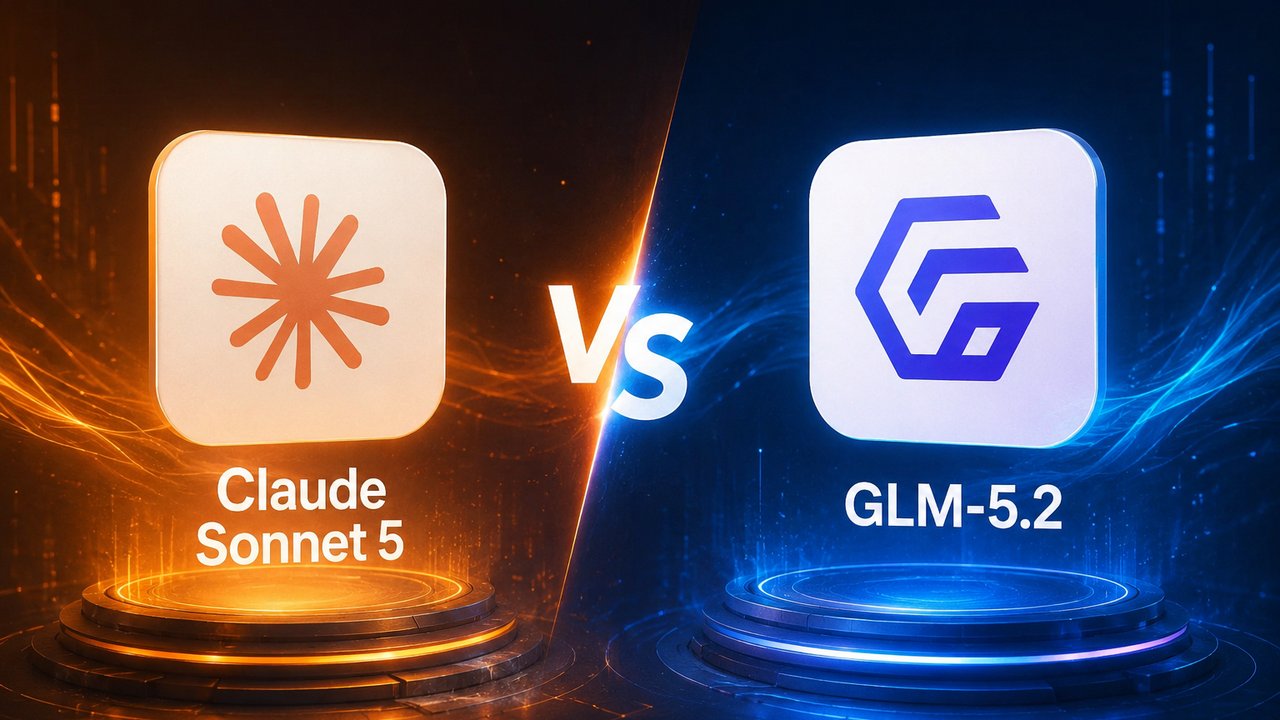
Claude Sonnet 5 vs GLM-5.2: Best Model for Coding and AI Agents?

By Nathan Cole
MyClaw Editorial
MyClaw
Run Best-in-Class AI Agents Now
Run OpenClaw or Hermes Agent on managed MyClaw hosting, so your AI agent stays online, updated, and ready for real work.
AI Takeaway:
- Which model is the safer default? Claude Sonnet 5, if you want a polished closed model, strong agent behavior, and easy access through the Claude ecosystem.
- Which model is the better value? GLM-5.2, if lower token cost, open-model control, and long-context coding matter most.
- Do the specs clearly decide the winner? No. Both support 1M context and 128K max output, so the real test is task stability.
- How should you choose? Run both on the same workflow, then compare finished work, tool reliability, cleanup time, and cost.
Quick Verdict: Claude Sonnet 5 vs GLM-5.2
Claude Sonnet 5 and GLM-5.2 are aimed at the same new reality: AI models are no longer just chat assistants. They browse, plan, code, call tools, manage files, and keep multi-step work moving. So the useful question is not just which model is smarter. It is which one holds up better when real work gets messy.
If you want the safer default, choose Claude Sonnet 5. It sits inside the broader Claude ecosystem, works naturally with Claude Code-style workflows, and is built for everyday agentic work. It is the better choice when you value consistency, platform maturity, and fewer surprises.
If you want the stronger value play, choose GLM-5.2. It is designed for long-horizon coding, has real open-model momentum, and its raw API pricing is much lower. That matters when an agent is reading repo files, retrying commands, inspecting logs, and running several tool loops before it finishes.
For a deeper Claude-only view, MyClaw's Claude Sonnet 5 review is a useful companion.
Specs and Pricing
Both models are unusually strong on paper. As of July 2026, they are not competing as lightweight chat models. They are competing as long-context engines for serious work.
| Feature | Claude Sonnet 5 | GLM-5.2 |
|---|---|---|
| Provider | Anthropic | Z.AI |
| Context window | 1M tokens | 1M tokens |
| Max output | 128K tokens | 128K tokens |
| Pricing | $3 input / $15 output per MTok after intro pricing | $1.40 input / $4.40 output per 1M tokens |
| Discount or cache pricing | $2 / $10 through August 31, 2026 | $0.26 cached input, limited-time free cache storage |
| Access posture | Closed, managed model | Open-model momentum plus API access |
| Best fit | Polished general agent work | Cost-sensitive long-context coding |
The cleanest way to think about cost is this: Sonnet 5 is priced like a premium managed model; GLM-5.2 is priced like a model built for heavy use. For one-off answers, the difference may not matter much. For long-running agents, it can matter quickly.
An agent that reads a codebase, inspects logs, writes changes, runs tests, fails once, tries again, and summarizes the final diff is not using one prompt. Lower input and output pricing gives GLM-5.2 more room for repeated attempts.
If you are comparing a wider set of models, the MyClaw models directory frames models by publisher, context window, capability, and agent workflow fit instead of treating them as isolated chatbots.
Coding, Refactoring, and Long-Horizon Work

For coding, the question is not whether a model can write a function. Most modern models can. The real question is whether it can hold a project in its head long enough to make a useful change without breaking repo rules.
Repository-Level Coding
Claude Sonnet 5 is strong for code review, planning, debugging, and implementation tasks where steady behavior matters. It fits naturally into Anthropic's tooling and should feel familiar if you already use Claude for software work.
GLM-5.2 gets more interesting when the project is large and the task is not just "write this component." Its pitch is project-scale context: read more code, preserve more architecture, and keep going through longer engineering loops.
Multi-Step Agent Tasks
Agent work adds pressure that normal chat does not. The model has to choose next steps, call tools, understand output, recover from errors, and avoid drifting away from the original instruction.
For that kind of work, Sonnet 5 has the advantage of polish. GLM-5.2 has the advantage of cost and open-model flexibility. If the task needs many iterations, GLM-5.2 becomes easier to justify. If the task is sensitive, Sonnet 5 may be the calmer default.
For Hermes-specific routing, MyClaw's guide to the best AI models for Hermes Agent gives a broader view of how model choice changes inside an agent runtime.
Web and Frontend Generation
GLM-5.2 has been getting attention for web and HTML generation, especially where structured frontend output matters. That does not mean it wins every creative task, but it does make it worth testing for landing pages, dashboards, internal tools, and quick prototypes.
Sonnet 5 is more of a balanced generalist. It may be less flashy on a single web-design leaderboard, but it is likely to be more predictable across mixed work: writing, coding, research, planning, and debugging.
Open Source Control vs Closed Model Reliability
This is the philosophical split, but it has practical consequences. GLM-5.2 appeals when you want control: more room for customization, more deployment optionality, and less dependence on one provider's product direction.
Claude Sonnet 5 appeals when you want a managed experience. Anthropic controls the model, safety layers, API behavior, and platform path. That can feel limiting, but it also reduces the number of decisions you have to make.
The tradeoff is simple:
- Choose open for control, cost flexibility, and deployment optionality.
- Choose closed for a cleaner support path, predictable access, and less model-ops burden.
- Use both if your workflows vary by risk, cost, and task type.
The Real Test Is the Workflow
A model comparison becomes much clearer when both models get the same job.
Good tests:
- Review a pull request and identify risky changes.
- Fix a failing test without changing public behavior.
- Audit a small codebase and summarize architectural debt.
- Monitor a competitor page and report meaningful changes.
- Use a browser to collect data, fill a form, or validate a page.
Browser and tool use are especially revealing. A strong model can still fail if its runtime gives it fragile selectors, weak session handling, or poor state management.
That is why skills matter. The Agent Browser skill, for example, uses ref-based browser automation, which can make web tasks more deterministic than relying on screenshots or brittle selectors.
Running Both Models in an Always-On Agent
 Once you know the tradeoffs, test both models in the same environment. A chat window is fine for first impressions, but it does not show how a model behaves with files, tools, memory, browser access, scheduled work, and real tasks to finish.
MyClaw gives you a managed OpenClaw or Hermes Agent instance with a private workspace, 24/7 uptime, tools, skills, files, backups, and browser-ready workflows. That makes the comparison more honest: give Sonnet 5 and GLM-5.2 the same task, then judge the result.
Step 1: Pick One Real Workflow
Start with something you actually need done: a repo audit, bug fix, SEO brief, inbox triage, weekly report, or browser monitoring task. The task should have a clear finish line.
Step 2: Run It Once With Each Model
Keep the setup identical: same files, same instructions, same success criteria, same tools. Start with Sonnet 5 as the polished baseline, then test GLM-5.2 for cost and long-context behavior.
Step 3: Score the Finished Work
Do not judge only the first response. Compare final output, corrections, tool-call reliability, latency, token cost, and whether the model respected your constraints.
Which Model Should You Use?
If you want one default model for everyday AI agent work, start with Claude Sonnet 5. It is the steadier pick for mixed tasks: planning, writing, coding, research, and browser work.
If your main use case is heavy coding, long-context repo work, or cost-sensitive agent loops, GLM-5.2 deserves a serious test. Its pricing makes repeated tool use less painful.
For coding workflows, the real answer may be model routing: Sonnet 5 for high-trust planning and delicate tasks; GLM-5.2 for large-context exploration, repeated implementation attempts, and cost-aware automation. The MyClaw coding agent workflow guide shows where that split becomes useful: PR reviews, tests, debugging, and repo maintenance.
Final Recommendation
Claude Sonnet 5 vs GLM-5.2 is not a search for a universal winner. It is a choice between two strong models with different advantages.
Claude Sonnet 5 is the safer default. It is polished, accessible, and well suited to general agent work. GLM-5.2 is the sharper value play. It is cheaper, more open, and compelling for long-context coding tasks where repeated tool loops can get expensive.
If your work happens mostly in a chat box, Sonnet 5 is probably the easier starting point. If your work happens inside repos, browsers, tools, and scheduled agent workflows, test both. The model that writes the best demo is not always the model that finishes the real task with the least supervision.
Skip the Setup, Run Best-in-Class AI Agents Now
Launch a managed OpenClaw or Hermes Agent workspace in minutes, with always-on hosting, updates, and support handled by MyClaw.