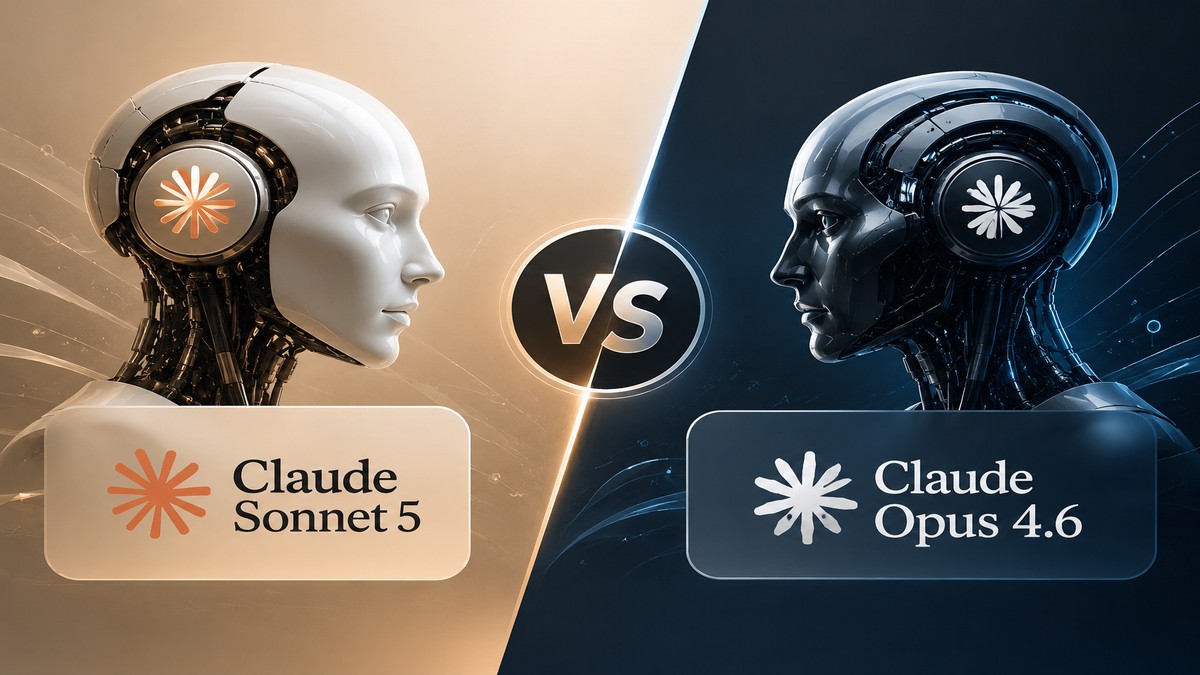
Claude Sonnet 5 vs Opus 4.6: Which Claude Model Should You Use for Coding Agents?

By Olivia Hart
MyClaw Editorial
MyClaw
Run Best-in-Class AI Agents Now
Run OpenClaw or Hermes Agent on managed MyClaw hosting, so your AI agent stays online, updated, and ready for real work.
AI Takeaway:
- Choose Claude Sonnet 5 as the default if you want a strong everyday model for coding agents, browser tasks, planning, and knowledge work without reaching for a heavier model on every run.
- Choose Claude Opus 4.6 when the task is long, difficult, or costly to redo: large codebase migrations, deep debugging, dense research, legal or financial analysis, and multi-step agent work.
- If you are comparing Claude Sonnet 5 vs 4.6, Sonnet 5 is the more future-ready default; Sonnet 4.6 still makes sense for stable, low-risk workflows that already perform well.
- The best setup is not picking one Claude model forever. Use Sonnet 5 for daily runs, escalate to Opus 4.6 when the work needs more depth, and keep cost and permissions visible.
Quick Verdict: Sonnet 5 for Daily Runs, Opus 4.6 for Hard Work
Claude Sonnet 5 is the better starting point for most coding-agent workflows. It fits the kind of work that happens all day: fixing bugs, writing tests, reviewing diffs, planning small features, browsing documentation, and handling structured knowledge tasks. If you run an agent often, the default model has to be fast, affordable, and reliable without making every request feel like a budget decision.
Claude Opus 4.6 is the model to reach for when the task has more at stake and it is available in your stack. It is better suited to work where the model needs to hold a lot of context, reason through several dependent steps, and avoid a bad early plan.
The simplest rule is this: Sonnet 5 for the default lane, Opus 4.6 for the deep lane. The MyClaw model directory is a practical place to compare options by workflow fit instead of choosing from the newest model name alone.
Claude Sonnet 5 vs Opus 4.6 Comparison
| Category | Claude Sonnet 5 | Claude Opus 4.6 |
|---|---|---|
| Best role | Daily driver | Deep specialist |
| Coding | Strong for routine implementation, tests, reviews, and fixes | Better for complex refactors, migrations, and multi-step debugging |
| Agent tasks | Good for frequent tool use and everyday automation | Useful for longer planning and harder autonomous runs |
| Context-heavy work | Enough for many practical tasks | Better when the task depends on large files, long histories, or many constraints |
| Cost profile | Better default for repeated work | Worth reserving for high-value tasks |
| Main risk | May need escalation on unusually complex work | Can be overkill for small tasks and expensive if used as the default |
Coding and Software Engineering
For normal software work, Sonnet 5 is the more sensible first choice. Most coding tasks are not one giant reasoning puzzle. They are a sequence of small decisions: inspect the code, find the failure, change a few files, run tests, adjust, and explain the result.
Opus 4.6 becomes more attractive when the task is not just "write code," but "understand the system." That includes framework migrations, brittle legacy code, unclear product requirements, security-sensitive changes, and issues where the first fix can create three new problems.
If your workflow is close to Claude Code or another coding-agent setup, think beyond the chat box. Agents need repositories, terminals, permissions, context files, logs, and review habits. The tradeoff shows up clearly in Hermes Agent vs Claude Code: the surrounding workflow often determines how useful the model feels.
Agent Workflows and Tool Use
Agents behave differently from chat models. A chat answer can be wrong and still be harmless. An agent can browse, edit files, run commands, call APIs, install packages, or continue a task while you are away.
Sonnet 5 works well here because many autonomous tasks are frequent and medium difficulty: summarize a repo, draft release notes, check a competitor page, organize files, prepare a support answer, or monitor a workflow.
Opus 4.6 is better when the agent has to plan over a longer horizon. If the task requires several phases, careful state tracking, and judgment about when to stop, the deeper model can be worth it.
Claude Sonnet 5 vs 4.6: What Actually Changes?
The Sonnet 5 vs 4.6 question is less about a single headline benchmark and more about whether the newer model reduces friction. The upgrade matters if it gives you fewer retries, cleaner plans, better tool choices, more stable code edits, and less manual correction.
Sonnet 4.6 can still be enough for simple or already-optimized workflows. If your prompts are stable, your tasks are low risk, and the model already completes them cheaply, there is no need to rebuild everything overnight.
Sonnet 5 makes more sense when the work has started to stretch the old model. Common signs include repeated corrections, shallow debugging, poor multi-file awareness, long tool loops, or results that look plausible but miss the actual constraint. Once an agent touches more tools, more files, or more business-critical work, a stronger default can reduce the total cost even if the sticker price is not the only thing you track.
The Hidden Cost: Tokens, Runtime, and Mistakes
Model cost is not only the price per million tokens. For agents, cost includes the whole run: planning messages, tool calls, file reads, browser steps, retries, context growth, and human review time. A cheaper model can become expensive if it takes five attempts.
The bigger issue is the cost of mistakes. Coding agents can delete files, change database migrations, expose secrets, modify infrastructure, or approve their own bad assumptions if the workflow gives them too much freedom. A strong model is useful, but it is not a substitute for scoped permissions, logs, backups, and review.
For software teams, inspectability belongs in the setup from day one. A coding-agent workflow should make it obvious what the agent tried, what it changed, what failed, and where the cost went.
One practical habit helps more than most model tweaks: keep session logs close to the work. They are not just records; they are how you debug the agent itself.
Run Claude Models in an Always-On OpenClaw Agent
For OpenClaw-style agents, the model does not live in isolation. It needs a runtime, a place to keep working, a way to access tools, and a control layer for cost and safety.
MyClaw hosts private OpenClaw instances so you can run Claude and other models inside an always-on agent workspace without maintaining the server yourself. The main advantage is flexibility: keep one agent environment, then choose Sonnet 5 or Opus 4.6 based on the task instead of rebuilding your setup every time the model choice changes.
Step 1: Start With Sonnet 5 as the Daily Driver
Use Sonnet 5 for routine coding, browser workflows, writing, research, support work, and everyday automation. It keeps the agent responsive and cost-aware for the tasks that happen often.
Step 2: Escalate Hard Runs to Opus 4.6
Switch to Opus 4.6 when the work becomes deep: large refactors, multi-file debugging, long-context analysis, migration planning, security reviews, or high-value research. Treat it like a specialist, not the default setting for every small task.
Step 3: Watch Usage Before You Scale
Before turning an agent task into a recurring workflow, check the logs, session behavior, and token usage. If a task loops or carries unnecessary context, fix the process before increasing the model tier.
Recommended Setup by Use Case
Solo Developer
Use Sonnet 5 for daily coding: issue triage, small features, tests, comments, docs, and pull request cleanup. Move to Opus 4.6 when you need architectural judgment or when a change touches too many files to comfortably review in one pass.
Startup or Small Team
Sonnet 5 is a strong default for engineering support, internal automation, customer-response drafts, and operational research. Opus 4.6 should be reserved for release-critical tasks, migration plans, incident analysis, or security-sensitive reviews.
If the agent is expected to act across repositories, tools, and recurring jobs, add workflow discipline early. For non-code investigations, a structured research-agent setup keeps the task grounded. For implementation work, a focused coding setup matters just as much as the model name because it shapes what the agent is allowed to do.
Research, Legal, and Finance Work
Use Opus 4.6 when the source material is long, dense, and expensive to misread. It is the better fit for contracts, policy analysis, financial documents, and multi-document synthesis. Use Sonnet 5 for summaries, extraction, first-pass organization, and follow-up drafts.
Always-On Personal Agent
For a personal agent that keeps running in the background, Sonnet 5 is usually the better baseline. Most always-on tasks are small: reminders, page checks, inbox organization, file cleanup, short research, and lightweight automation. Opus 4.6 should appear when the work needs slower thinking, not every time the agent wakes up.
Final Recommendation: Choose by Workflow
Claude Sonnet 5 vs Opus 4.6 is not a winner-takes-all comparison. Sonnet 5 is the better everyday model for coding agents and OpenClaw-style automation because it fits frequent, practical work. Opus 4.6 remains the stronger choice for deep, long-context, high-stakes tasks where a better first plan can save hours.
If the question is Claude Sonnet 5 vs 4.6, the answer is simpler: Sonnet 5 is the model to build around for new workflows, while Sonnet 4.6 remains acceptable for stable, low-risk tasks that already perform well.
The smartest setup is flexible. Start with Sonnet 5, escalate to Opus 4.6 when the work deserves it, and keep the agent environment observable enough that cost, mistakes, and tool behavior never become invisible.
Skip the Setup, Run Best-in-Class AI Agents Now
Launch a managed OpenClaw or Hermes Agent workspace in minutes, with always-on hosting, updates, and support handled by MyClaw.