Gemini 3.6 Flash vs 3.5 Flash: Coding, Speed & Cost

By Olivia Hart
MyClaw Editorial
MyClaw
Run Best-in-Class AI Agents Now
Run OpenClaw or Hermes Agent on managed MyClaw hosting, so your AI agent stays online, updated, and ready for real work.
AI Takeaway
- Which model is better for coding? Gemini 3.6 Flash is the stronger default. It leads 3.5 Flash in Google’s software-engineering, terminal, computer-use, and long-context evaluations.
- Is 3.6 much smarter? Not across the board. Artificial Analysis gives both models the same Intelligence Index score. The upgrade is better understood as faster, more efficient execution than a large jump in raw intelligence.
- Is Gemini 3.6 Flash cheaper? Input pricing is unchanged, while output pricing drops from $9 to $7.50 per million tokens. The newer model also uses fewer output tokens and completes multi-step work in fewer turns.
- Should every 3.5 user migrate now? Test first. An established workflow can still regress in structured output, function calls, or visual styling.
- What should you measure? Compare accepted patches, passed tests, retries, unwanted edits, total time, and cost per completed task—not just benchmark scores or token prices.
Gemini 3.6 Flash vs 3.5 Flash at a Glance
Gemini 3.6 Flash keeps the same 1M context, 64K maximum output, multimodal inputs, and medium default thinking level. What changes is the execution: lower output cost, fewer tokens and tool calls, and shorter revision loops.
| Category | Gemini 3.6 Flash | Gemini 3.5 Flash |
|---|---|---|
| Best fit | New coding agents, refactors, terminal loops, multimodal workflows | Existing Flash workflows that have already passed regression tests |
| Status | Generally available and stable | Earlier generally available Flash model |
| Context / maximum output | 1M / 64K tokens | 1M / 64K tokens |
| Standard API price per 1M tokens | $1.50 input / $7.50 output | $1.50 input / $9 output |
| Default thinking level | Medium | Medium |
| Main difference | Fewer tokens, turns, tool calls, and revision loops | Higher output cost and slower task completion |
If 3.5 already returns valid schemas, calls tools correctly, and produces trusted patches, test those behaviors again before moving production traffic.
Gemini 3.5 Flash-Lite is also a separate model, not another name for 3.5 Flash. The Gemini 3.5 Flash model overview covers the older model’s original limits and benchmark profile in more detail.
Is Gemini 3.6 Flash Better for Coding?
For most new coding-agent work, yes. The strongest gains appear in long-running engineering, machine-learning work, and large-context retrieval rather than isolated functions.
Long-Horizon Coding and Repository Work
Google’s current direct comparison shows the following results:
| Benchmark | Gemini 3.6 Flash | Gemini 3.5 Flash | Difference |
|---|---|---|---|
| SWE-Bench Pro | 58.7% | 55.1% | +3.6 points |
| DeepSWE v1.1 | 49% | 37% | +12 points |
| MLE-Bench | 63.9% | 49.7% | +14.2 points |
| Terminal-Bench 2.1 | 78.0% | 76.2% | +1.8 points |
| OSWorld-Verified | 83.0% | 78.4% | +4.6 points |
The DeepSWE and MLE-Bench gains matter when a job lasts longer than one prompt. A repository migration may require inspecting modules, planning, editing, running commands, reading failures, and recovering from a wrong assumption. Staying on track through that sequence matters more than producing one impressive snippet.
Both models accept 1M tokens, yet 3.6 scores 91.8% versus 77.3% at the 128K average on GDM-MRCR v2. At 1M, the scores are 54.0% versus 26.6%. Context size describes capacity, not reliable retrieval.
Terminal Work, Debugging, and Tool Calls
Gemini 3.6 Flash is designed to reduce compile failures, unnecessary revisions, and loops that consume tokens without progressing. It also shows less action bias, making it more likely to inspect a read-only problem before changing files.
In a coding-agent workflow with repository and terminal access, “Did it stop after finding the cause?” and “Did it avoid unrelated files?” matter more than whether the code looks convincing.
Functional Frontend Code Still Needs Visual Direction
Google reports stronger functional code from 3.6, while human evaluators sometimes preferred earlier models for layout and styling. A component can compile and still miss the intended design.
For frontend work, provide screenshots, spacing rules, breakpoints, component constraints, and visual review. Stronger implementation does not guarantee better design.
Faster and Cheaper Does Not Mean Smarter
Artificial Analysis gives both models the same Intelligence Index score of 50. Google appears to have improved how efficiently 3.6 reaches a result without raising its broad intelligence score.
The Biggest Upgrade Is Time per Task
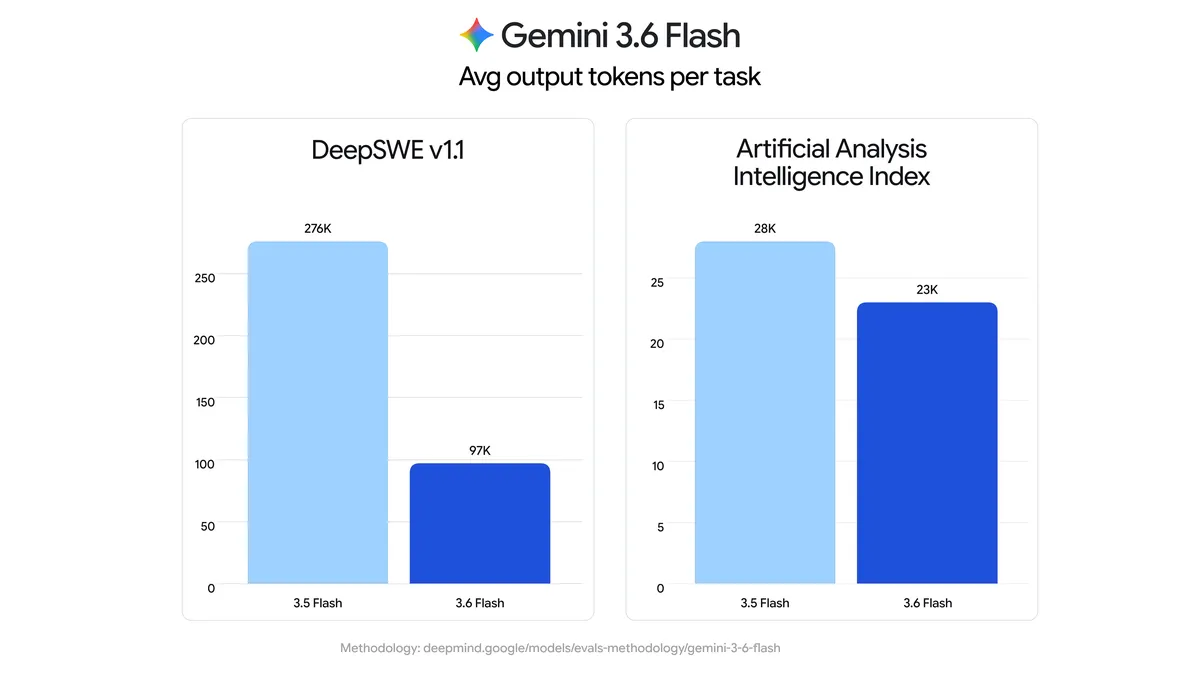
In the same high-reasoning test, average task time falls from about 2.7 minutes with 3.5 to 1.3 minutes with 3.6. The newer model produced roughly 304 output tokens per second and cut average task cost from about $0.59 to $0.50.
Google also reports 17% fewer output tokens, plus fewer reasoning steps and tool calls. Across debugging sessions, scheduled jobs, or parallel agents, shorter loops improve throughput and total spend.
The same principle applies when comparing Flash with a deeper reasoning model. The earlier Gemini 3.1 Pro vs 3.5 Flash comparison shows why the cheapest token price does not always produce the cheapest completed task.
Measure Cost per Accepted Result
A useful calculation is:
(model spend + retries + developer review + repair time) ÷ accepted tasks
Track passed tests, elapsed time, failed tool calls, unrelated edits, and cleanup. A modest benchmark gain is valuable if it removes a debugging loop. Speed saves nothing if someone spends another twenty minutes repairing the result.
Which Gemini Flash Model Should You Use?
Choose Gemini 3.6 Flash first for new full-stack refactors, bug fixes, code migrations, terminal workflows, large repositories, and repeated tool use. It offers the better current mix of completion quality, speed, token efficiency, and output price.
Keep Gemini 3.5 Flash temporarily when an existing production workflow has already been tuned around its behavior. Structured extraction, strict JSON, custom function calls, and frontend generation can break even when the replacement model is stronger overall. Move one workflow at a time and keep the old path available until the new one reaches the same accepted-result rate.
You do not have to standardize on one model for every coding task. A team might use 3.6 for implementation and retain another model for architecture review or a sensitive final check. If the work is mostly autocomplete, short IDE edits, or occasional repo help, this guide to the best AI coding assistants compares options built for those workflows.
Test Both Models on a Real Repository
Two chat windows are not a fair test. The models need the same repository, tools, permissions, thinking level, time limit, and definition of done. MyClaw provides an always-on OpenClaw or Hermes Agent workspace where those conditions stay fixed while the model changes. Confirm provider availability before starting.
Step 1: Give the Models a Job That Can Fail
Use a contained branch and a concrete task: repair a failing test, refactor one module, or migrate an API. Set pass conditions and a time or spending limit. Require passing tests and a reviewable diff.
Step 2: Run Two Clean Coding Sessions
Start a separate session for each model with identical files, tools, permissions, prompts, thinking levels, and test commands. Do not let the second model inherit the first model’s attempted fix or history. If budget allows, repeat each run three times so one lucky result does not decide the comparison.
Step 3: Put the Winner Back to Work
Compare accepted patches, test results, time, retries, token cost, unwanted edits, and cleanup. Use the winner for that task and keep the other as a reviewer or fallback. A backend migration and visual frontend build may have different winners.
What Changes When You Migrate from 3.5 to 3.6?
Changing the model ID to gemini-3.6-flash is only the first step. Google’s migration guidance documents API behavior that can break even when the prompt remains unchanged.
Update More Than the Model ID
Before switching traffic:
- remove custom
temperature,top_p, andtop_kvalues where they are unsupported; - replace
thinking_budgetwiththinking_level; - remove unsupported
candidate_countsettings; - remove prefilled model turns and use the documented server-side conversation pattern;
- preserve thought signatures where required;
- recheck function-call IDs, names, multimodal response payloads, and structured outputs.
A malformed tool call can stop an agent halfway through, while a changed stop condition can start another expensive loop. In a persistent OpenClaw environment, migrate scheduled work and existing sessions gradually.
Run a Short Regression Checklist
Test schema validity, tool selection, stop behavior, patch size, visual output, latency, retries, and fallbacks. Start with low-risk traffic and keep 3.5 available until 3.6 matches or improves the accepted-result rate.
Conclusion
In the Gemini 3.6 Flash vs 3.5 Flash decision, 3.6 is the better default for most new coding-agent work. It completes tasks faster, uses fewer output tokens, costs less on output, and improves several important software-engineering evaluations. It is an engineering and efficiency upgrade rather than a dramatic leap in raw intelligence. Before replacing a stable 3.5 workflow, run both models on the same repository task and choose the one that produces accepted work with less cleanup.
Skip the Setup, Run Best-in-Class AI Agents Now
Launch a managed OpenClaw or Hermes Agent workspace in minutes, with always-on hosting, updates, and support handled by MyClaw.