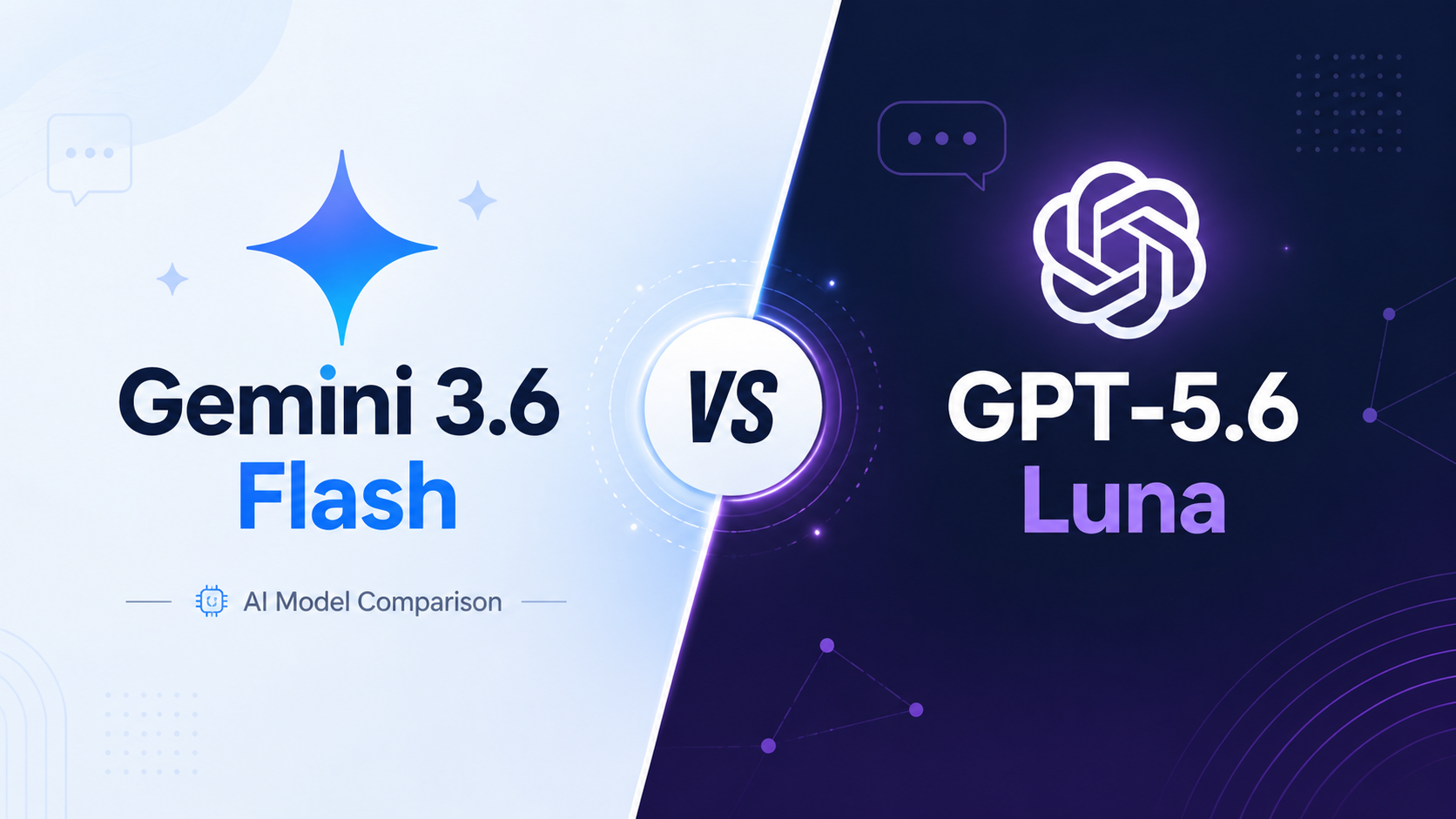
Gemini 3.6 Flash vs GPT-5.6 Luna: Coding & Cost

By Julian Brooks
MyClaw Editorial
MyClaw
Run Best-in-Class AI Agents Now
Run OpenClaw or Hermes Agent on managed MyClaw hosting, so your AI agent stays online, updated, and ready for real work.
AI Takeaway
- Which model is better overall? Neither wins every category. GPT-5.6 Luna is the stronger starting point for coding, terminal work, knowledge tasks, and lower token prices. Gemini 3.6 Flash is stronger for computer use, multimodal inputs, charts, and long-context retrieval.
- Which model is cheaper? Luna costs $1 per million input tokens and $6 per million output tokens, compared with $1.50 and $7.50 for Gemini 3.6 Flash. The useful number is still cost per accepted task after retries and tool calls.
- Which is faster? Gemini generates output very quickly, but output speed is not the same as first-token latency or total task time.
- Which is better for coding agents? Luna leads Google’s published DeepSWE and Terminal-Bench comparisons. Gemini leads OSWorld computer use and several long-context and multimodal tests.
- Which should you deploy? Start with the model that best matches the job, test it on repeatable work, and keep the other available as a specialist or fallback.
Gemini 3.6 Flash vs GPT-5.6 Luna at a Glance
Luna is cheaper and stronger on several coding-agent tests. Gemini is more versatile when a workflow involves media, computer control, or large collections of source material. Gemini 3.6 Flash became generally available on July 21, 2026, so comparisons that still list its price or specifications as unconfirmed are out of date.
| Category | Gemini 3.6 Flash | GPT-5.6 Luna |
|---|---|---|
| Best fit | Computer use, multimodal analysis, long-context workflows | Coding, terminal work, knowledge work, high-volume agents |
| API price per 1M tokens | $1.50 input / $7.50 output | $1 input / $6 output; $0.10 cached input |
| Context / maximum output | 1,048,576 / 65,536 tokens | 1,050,000 / 128,000 tokens |
| Inputs | Text, image, video, audio, PDF | Text, image |
| Reasoning | Thinking supported; medium default | Reasoning tokens and adjustable effort |
| Provider tools | Search, Maps, code execution, file search, computer use preview | Web and file search, code interpreter, shell, computer use, MCP, skills |
The figures come from the official Gemini 3.6 Flash specifications and GPT-5.6 Luna specifications. Tool availability depends on the API surface and account.
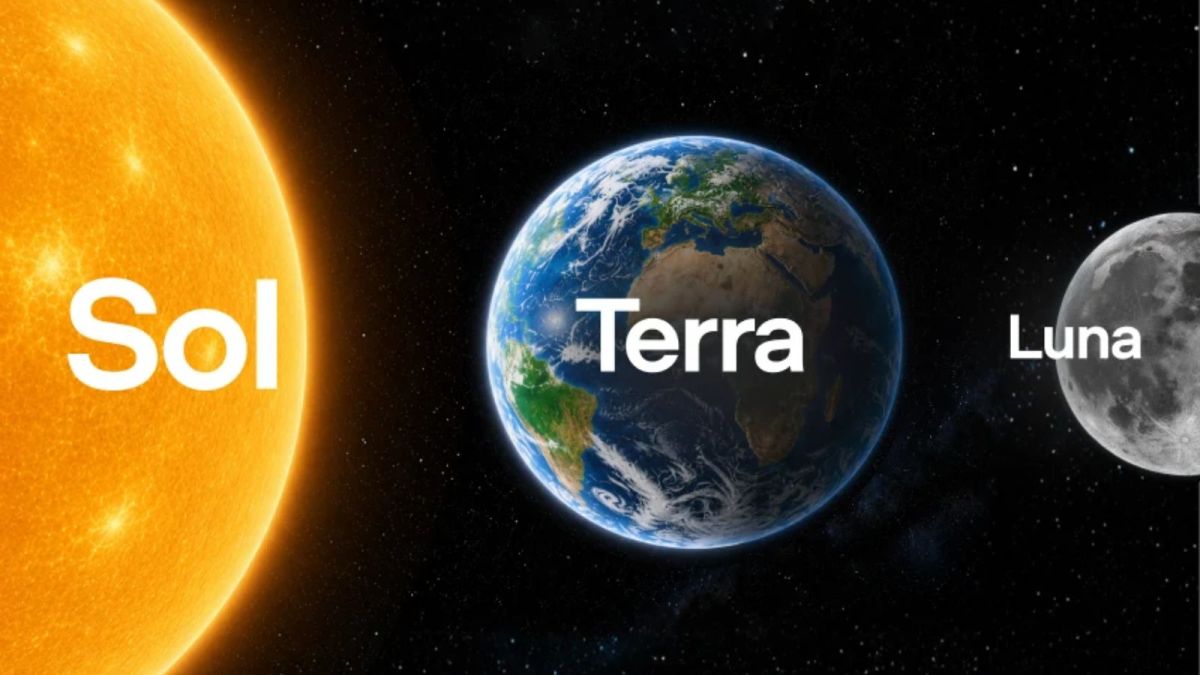
GPT-5.6 is a family: Sol is the flagship, Terra is balanced, and Luna is fast and affordable. That makes Luna the fairest match for Flash here. The broader GPT-5.6 Sol vs Terra vs Luna guide explains when moving up makes sense.
Which Model Wins the Benchmarks That Matter?
Benchmarks show a clear split rather than a clean sweep. They are a map of strengths, not a recreation of a particular repository or tool setup. Reasoning levels and agent harnesses can differ, so small gaps deserve less weight than large, consistent ones.
Coding, Terminal Work, and Knowledge Tasks
Google’s direct comparison gives Luna the advantage on the main software-engineering and knowledge-work evaluations.
| Benchmark | Gemini 3.6 Flash | GPT-5.6 Luna | Lead |
|---|---|---|---|
| SWE-Bench Pro | 58.7% | 62.7% | Luna |
| DeepSWE v1.1 | 49% | 67% | Luna |
| Terminal-Bench 2.1 | 78.0% | 84.7% | Luna |
| GDPval-AA v2 | 1421 Elo | 1584 Elo | Luna |
The DeepSWE gap is relevant to coding agents. A repair may require inspecting files, changing code, running tests, and correcting a bad assumption. Luna is the better first test for that sequence.
That does not make it the right model for every difficult task. If a job needs stronger judgment, security analysis, or a final review, the GPT-5.6 Sol model overview covers the higher-capability end of the same family.
Computer Use, Multimodal Work, and Long Context
Gemini’s advantage appears when the work moves beyond text and terminal commands:
- MLE-Bench: 63.9% for Gemini versus 47.6% for Luna.
- OSWorld-Verified: 83.0% versus 72.6%.
- CharXiv without tools: 85.2% versus 82.7%.
- GDM-MRCR v2 at a 128K average: 91.8% versus 74.8%.
Both models advertise roughly 1M tokens of context, but capacity is not the same as reliable retrieval. Gemini’s long-context result suggests it is more likely to recover the needed detail from a large evidence set. Native PDF, video, and audio inputs also reduce the preprocessing required for document-heavy or visual work.
Speed and Cost: Look Beyond the Token Price
Luna Has the Lower Rate Card
Luna is 33% cheaper on input and 20% cheaper on output. For a task using 50,000 input tokens and producing 5,000 output tokens, the basic rate-card estimate is $0.08 on Luna and $0.1125 on Gemini. At hundreds of scheduled runs, that difference becomes meaningful.
The estimate is only a starting point. Reasoning tokens, caching, long-context price rules, tool fees, and retries can change the total. Gemini also uses tokens efficiently compared with the previous Flash generation, so the gap between the two models may be smaller in a completed workflow than the list price suggests. The recent Gemini 3.6 Flash vs 3.5 Flash comparison shows why fewer turns and shorter revision loops can matter as much as the published output rate.
Fast Output Does Not Guarantee the Fastest Finished Task
Speed has three different meanings:
- time to first token;
- output tokens per second;
- total time to a correct, accepted result.
Independent testing shows very high output throughput for Gemini 3.6 Flash, but an agent may still spend time reasoning, calling tools, recovering from errors, or revising an incomplete result. Record P50 and P95 completion time, retries, failed tool calls, token use, and cleanup. The fastest stream of text is not necessarily the fastest route to finished work.
Which Model Should You Use?
Choose Gemini 3.6 Flash for Visual and Tool-Heavy Work
Gemini is the stronger fit for PDF analysis, video or audio review, chart interpretation, browser tasks, and research across large source sets. It is also attractive when an agent must interact with software rather than only produce an answer. Its OSWorld and long-context results support that role.
Choose GPT-5.6 Luna for Code and High-Volume Work
Luna is the better default to test for repository work, terminal loops, structured summaries, routine knowledge tasks, and recurring automation. Its lower token price compounds as the same job runs across many projects or schedules.
For a practical coding evaluation, give both models a contained issue with a passing test as the finish line. A hosted coding-agent workflow makes it possible to compare patches, command history, retries, and test results instead of judging two isolated chat answers.
The simplest routing rule is to use Luna for repeatable text and coding work, then call Gemini when the task needs richer media, computer interaction, or stronger retrieval from long inputs. Sensitive work still needs review, regardless of which model produced it.
Stop Guessing: Put Both Models on the Same Job
Benchmark tables end where the actual work begins. MyClaw provides a managed, always-on OpenClaw or Hermes Agent workspace where files, tools, permissions, and success criteria can remain fixed while the model changes. Confirm current provider access and the exact model IDs before starting.
Step 1: Launch a Private Agent Workspace
Create an isolated agent, connect the approved provider or compatible API access, and expose only the files and tools required for the test. Choose a job that can clearly succeed or fail: repair a broken test, complete a browser action, or produce a sourced report with required fields.
Step 2: Run Two Clean Sessions
Give Gemini 3.6 Flash and GPT-5.6 Luna the same prompt, context, permissions, reasoning level, time limit, and spending cap. Start from clean sessions so the second model does not inherit the first model’s attempted fix. Run each job more than once if the budget allows; one lucky result should not decide a production default.
Step 3: Keep the Winner—and Route the Rest
Compare accepted results, total runtime, retries, tool errors, token cost, and cleanup. Make the winner the primary model for that specific workflow. The other model can remain available for multimodal tasks, coding escalations, or fallback when the primary route is unavailable.
Production Details That Can Change the Decision
Model quality is only part of deployment. Gemini’s PDF, audio, and video inputs may remove conversion steps. Luna’s 128K maximum output is almost twice Gemini’s 65,536-token limit, which can matter for long code or detailed reports. Caching, rate limits, regional access, and long-context pricing also affect the bill.
Upgrades can change structured outputs, tool calls, stop behavior, and supported parameters. Move low-risk traffic first, set a spending cap, retain task logs, and keep a fallback until the new route is stable. A persistent OpenClaw hosting environment keeps scheduled work, files, and agent state available when a laptop sleeps.
Conclusion
In the Gemini 3.6 Flash vs GPT-5.6 Luna decision, Luna is the better default for coding, terminal work, knowledge tasks, and lower token cost. Gemini is the better specialist for computer use, multimodal inputs, and long-context retrieval. Choose from a defined job: use the model that finishes it with fewer retries, less cleanup, and a lower cost per accepted result.
Skip the Setup, Run Best-in-Class AI Agents Now
Launch a managed OpenClaw or Hermes Agent workspace in minutes, with always-on hosting, updates, and support handled by MyClaw.