Gemini 3 Flash vs Qwen 3.5: Which Should You Use for AI Agents?

By Alex Morgan
MyClaw Editorial
MyClaw
Run Best-in-Class AI Agents Now
Run OpenClaw or Hermes Agent on managed MyClaw hosting, so your AI agent stays online, updated, and ready for real work.
AI Takeaway
- Best default: Gemini 3 Flash is the easier first pick for fast hosted AI work with strong reasoning, multimodal support, and low setup friction.
- Best for control: Qwen 3.5 is more attractive when deployment flexibility, Chinese/English workflows, open-weight options, or provider independence matter.
- Best hosted Qwen path: Qwen 3.5 Plus is worth testing when you want stronger managed Qwen capability without running inference yourself.
- Best private deployment path: Qwen 3.5 27B-style models make sense when privacy, GPU cost, customization, and repeatable workloads matter more than convenience.
- For real agents: the model is only one layer. Long-running work also needs tools, memory, scheduling, permissions, logs, and a stable runtime.
Quick Verdict: Gemini 3 Flash Is Easier, Qwen 3.5 Is More Flexible
If you need a practical starting point, try Gemini 3 Flash first. It is fast, broadly capable, and easy to plug into hosted workflows. If you care more about where the model runs, how costs behave at scale, or how it handles multilingual and private work, Qwen 3.5 deserves a closer look.
A chatbot can look good after one response. An agent has to read files, call tools, retry after failures, wait for scheduled work, and finish something reviewable. That makes reliability and cost per completed task more useful than a single benchmark score.
| Need | Better First Test | Why |
|---|---|---|
| Fast everyday tasks | Gemini 3 Flash | Strong hosted default |
| Open or flexible deployment | Qwen 3.5 | More control over inference |
| Managed Qwen quality | Qwen 3.5 Plus | Stronger hosted Qwen path |
| Private repeatable workloads | Qwen 3.5 27B | Useful when infrastructure control matters |
| Long-running agent work | Depends | Measure completed work, not only token price |
What These Model Names Actually Mean
Gemini 3 Flash
 Gemini 3 Flash is Google’s speed-focused Gemini model. Its strength is convenience: strong general capability, fast response time, multimodal understanding, and hosted access. It is a good first model for summaries, visual checks, document review, lightweight coding help, and frequent small tasks.
Qwen 3.5
 Qwen 3.5 is part of Alibaba’s Qwen model family. Its appeal is broader than raw model quality: coding, multilingual work, agentic tasks, and flexible deployment. That matters if you work with private files, Chinese/English material, internal tools, or infrastructure you want to control.
Qwen 3.5 Plus
Qwen 3.5 Plus is the stronger managed Qwen option. It fits teams that want higher-end Qwen capability without managing model serving. The tradeoff is less control than a self-hosted route, so check pricing, API availability, and regional access before building around it.
Qwen 3.5 27B
Qwen 3.5 27B-style models are an infrastructure decision as much as a model decision. They can make sense for private inference, repeatable internal workflows, cost planning, and customization. The catch: you still need GPU capacity, monitoring, updates, and fallback plans.
Speed, Cost, and Access
Gemini 3 Flash wins when speed and simplicity matter. It is the better first test if you want strong results quickly without model-serving work. Qwen 3.5 wins when control is part of the requirement: local inference, provider choice, private workflows, or cost tuning around repeatable tasks.
The hidden cost is cleanup. A cheap model that needs four retries, misses a source, or breaks a tool call can become expensive. A higher-priced model that completes the task cleanly may cost less in practice. For a nearby comparison with the same “agent work over leaderboard score” lens, see MyClaw’s article on Gemma 4 vs Qwen 3.6.
Reasoning, Coding, and Tool Use
Reasoning and Research
Gemini 3 Flash is a strong default for broad reasoning, source summarization, and fast research synthesis: a quick plan, a clean comparison, or a first pass over messy information.
Qwen 3.5 becomes more interesting when reasoning needs to happen inside a controlled environment: multilingual sources, private documents, internal reports, or open-model workflows.
Coding and Automation
For coding, skip toy prompts. Use real repo work:
- inspect the codebase
- identify the right files
- make a small patch
- run the relevant checks
- explain what changed and what still needs review
Gemini 3 Flash is a good first model for quick debugging, code explanations, and lightweight edits. Qwen 3.5 is worth testing for longer coding loops, local tool use, repo maintenance, and private deployment. This is why comparisons such as Gemini 3.1 Pro vs GPT-5.4 are more useful when they focus on thinking, coding, and agent workflows instead of raw scores alone.
Tool Use Is the Real Test
Agent work reveals habits that a normal chat test hides. A model may write a polished answer but fail when it needs to use a browser, parse a file, retry after an API timeout, or stop before making too many changes.
Use a simple scorecard:
| Metric | What to Check |
|---|---|
| Completion | Did the task finish? |
| Accuracy | Are the claims or edits correct? |
| Tool discipline | Did it use tools at the right moments? |
| Recovery | Did it handle failures cleanly? |
| Cleanup | How much editing remains? |
| Cost | What did the finished result cost? |
Multimodal Work: Images, Video, Audio, and Long Context
Gemini 3 Flash is the easier first pick for everyday multimodal tasks: screenshots, PDFs, product images, visual summaries, UI analysis, and quick document understanding.
Qwen’s broader family is more compelling when multimodal work overlaps with multilingual tasks, custom deployment, or private infrastructure. The practical split is simple: choose Gemini for easy hosted multimodal work; choose Qwen when control matters as much as output quality.
Which Model Should You Choose?
Choose Gemini 3 Flash If
- You want the easiest strong default.
- You care about speed and low latency.
- You do not want to manage model hosting.
- Your work is broad: summaries, research, screenshots, coding help, and daily automation.
Choose Qwen 3.5 or Qwen 3.5 Plus If
- You want a serious alternative outside Google’s ecosystem.
- You work across English and Chinese.
- You care about coding agents or tool-heavy workflows.
- You compare cost and availability across regions or providers.
Choose Qwen 3.5 27B If
- You want more control over where inference runs.
- You have predictable, repeatable workloads.
- You value privacy, customization, or cost planning over convenience.
- You are willing to measure quality across multiple runs.
Match the Model to the Job
Inbox Triage and Daily Briefings
For email, the model has to summarize accurately, separate urgent from routine, and preserve enough context for review. The connector matters as much as the model. A workflow built with the MyClaw Gmail skill can show whether Gemini or Qwen handles real inbox context better than a pasted email sample.
Coding Loops and Repo Work
Coding agents need discipline. The best model is not always the one that writes the longest patch. It is the one that understands the repo, changes the smallest useful thing, runs checks, and explains the risk.
Competitor Monitoring and Web Research
Monitoring work is a strong agent benchmark because it repeats. The agent has to check sources, notice changes, ignore noise, preserve links, and report only what matters. MyClaw’s competitor monitoring use case is a better test than asking each model to summarize one landing page.
Private Workflows
Private workflows change the tradeoff. If the task touches internal code, sensitive files, customer data, or business plans, Qwen 3.5 27B-style deployment can become more attractive.
Running Gemini and Qwen Inside a Real AI Assistant
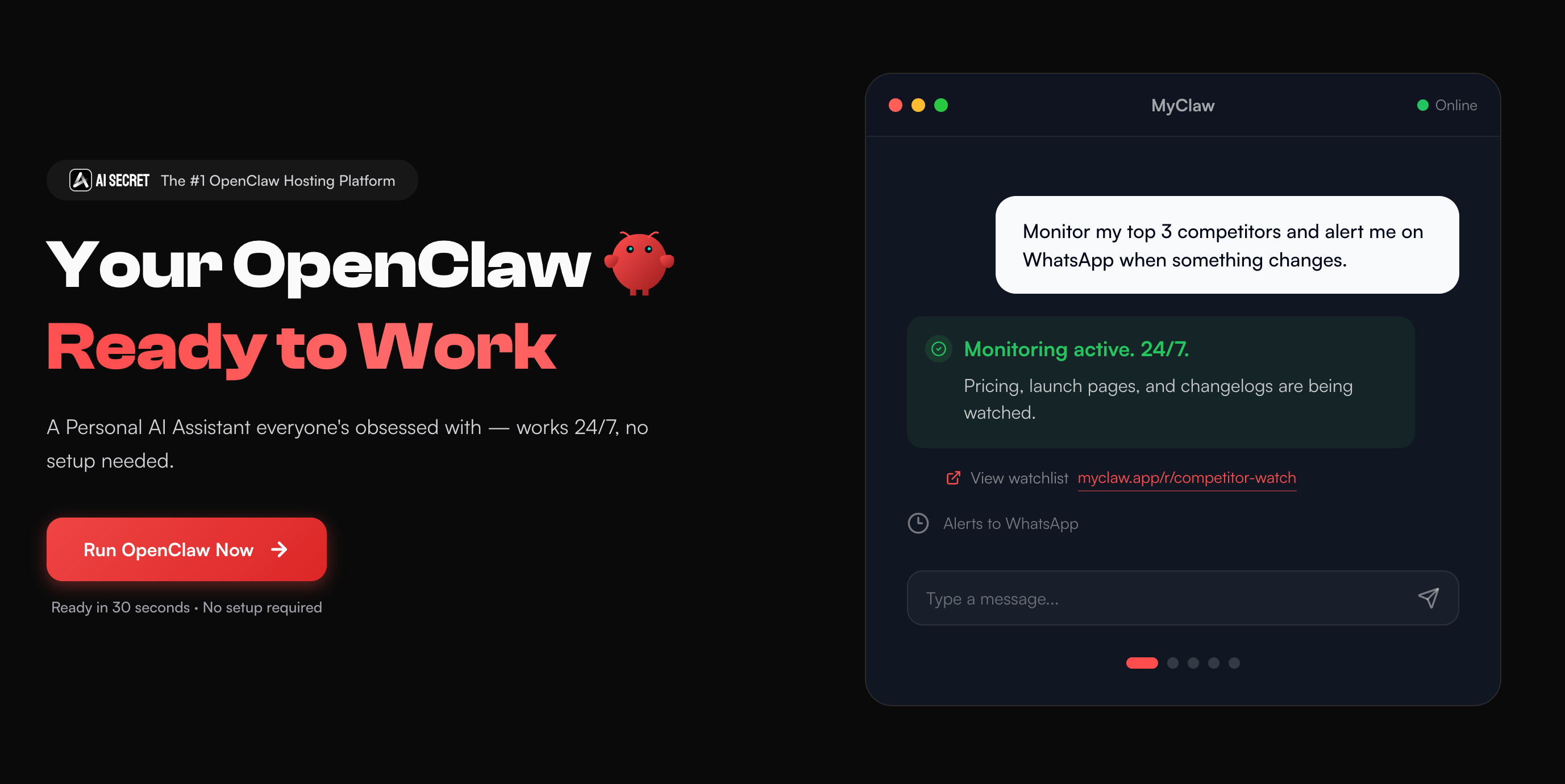 OpenClaw-style agents are different from chatbots. They can run scheduled tasks, use tools, connect to apps, and keep working after the first prompt. That makes the comparison more honest.
With MyClaw, you can run a private OpenClaw instance without setting up servers, updates, connectors, or always-on infrastructure. Gemini, Qwen, Claude, GPT, DeepSeek, or another provider can be tested against the same workflow in the same environment.
Try This in 3 Steps
- Pick one job your agent should actually finish: Gmail triage, WhatsApp competitor alerts, a weekly research deck, a code review loop, or a scheduled market report.
- Run the same job with Gemini first, then with Qwen. Keep the prompt, connectors, schedule, and review rules the same.
- Choose the model that finishes cleanly with fewer retries, better source handling, and lower operating cost.
MyClaw does not make one model the winner for every task. It gives the assistant a stable place to run and makes it easier to match the model to the work.
Final Recommendation
For Gemini 3 Flash vs Qwen 3.5, the simplest rule is this: start with Gemini 3 Flash if you want a fast hosted default, and start with Qwen 3.5 if you want more control, deployment flexibility, or a serious non-Google option. Choose Qwen 3.5 Plus when you want managed Qwen capability. Consider Qwen 3.5 27B when you are ready to own the infrastructure tradeoffs.
The best model is the one that completes the task reliably, at a cost you can live with, in an environment you trust. Put both models into the same workflow, give them the same tools and budget, and judge the finished work.
Skip the Setup, Run Best-in-Class AI Agents Now
Launch a managed OpenClaw or Hermes Agent workspace in minutes, with always-on hosting, updates, and support handled by MyClaw.