GPT-5.6 Sol vs Fable 5: Price, Access, and Real Agent Work

By Alex Morgan
MyClaw Editorial
MyClaw
Run Best-in-Class AI Agents Now
Run OpenClaw or Hermes Agent on managed MyClaw hosting, so your AI agent stays online, updated, and ready for real work.
Start HostingAI Takeaway:
- Best quick answer: GPT-5.6 Sol vs Fable 5 is not a simple "which model is smarter" comparison. The useful decision is access, price, safeguards, and whether the model can finish real agent work.
- Best on reported price: The Verge reported GPT-5.6 Sol at $5/M input and $30/M output, compared with Claude Fable 5 at $10/M input and $50/M output. Pricing can change, so verify current provider docs before production use.
- Best for OpenAI frontier workflows: GPT-5.6 Sol is the flagship model in OpenAI's GPT-5.6 family, above Terra and Luna, with attention around coding, cybersecurity, biology, and long-horizon agent tasks.
- Best for Claude Code-style workflows: Fable 5 is stronger to evaluate around long-horizon coding, Claude Code, vision-heavy documents, and safeguarded general agent work.
- Best practical choice: Test the same workflow with the models you can actually access, keep a fallback model, and preserve files, tools, and task state.
GPT-5.6 Sol vs Fable 5 at a Glance
GPT-5.6 Sol has the cleaner cost story and the strongest OpenAI positioning. Claude Fable 5 has the clearer fit for Claude Code-style development, long-running coding tasks, and vision-heavy knowledge work.
The bigger issue is availability. Axios reported that GPT-5.6 launched as a limited preview for around 20 government-approved companies. Business Insider also reported that OpenAI is starting with a small group of trusted partners before broader release. On the Anthropic side, The Verge reported that Mythos 5 returned for selected cyber defenders and infrastructure providers, while Fable 5 remained in limbo.
| Area | GPT-5.6 Sol | Claude Fable 5 |
|---|---|---|
| Provider | OpenAI | Anthropic |
| Family role | Flagship GPT-5.6 model | General-use Mythos-class Claude model |
| Related models | Terra for balanced work; Luna for fast, high-volume work | Mythos 5 for more restricted trusted-access work |
| Reported pricing | $5/M input, $30/M output | $10/M input, $50/M output |
| Access status | Limited preview, government-reviewed rollout | Public-facing access remains constrained |
| Best fit | Frontier reasoning, coding, cyber review, long-horizon agents | Claude Code, repo work, documents, vision, safeguarded agents |
For a wider view of model choices beyond these two names, MyClaw's AI models directory is useful because it frames models around agent workflows rather than only chat benchmarks.
What GPT-5.6 Sol Is Built For

Frontier Reasoning and Coding
Sol is most interesting for work where the model has to make several good decisions before acting. That includes large codebase changes, security review, technical planning, data extraction, and long-form analysis.
For coding, the test is not "can it write a function?" The test is whether it can inspect a repo, find the right files, make a small patch, run checks, read the failure, and recover. If Sol reduces failed turns, its real cost may be lower than the token price suggests.
Max, Ultra, and Sub-Agent Work
The Verge reported that Sol includes a "max" mode for deeper reasoning and an "ultra" mode for leveraging sub-agents. That is the detail worth watching. Agent work often needs multiple parallel threads: one path investigates the bug, another checks dependencies, another drafts the patch, and another verifies the result.
That makes Sol worth testing for migration planning, dependency audits, vulnerability review, report generation, and technical research with evidence.
The Access Problem
Sol may be powerful, but limited access changes the decision. If you cannot use it in your product, CI workflow, security process, or coding environment, it is not the best model for that job yet.
The practical question is not only "is Sol better?" It is "can I use Sol for this exact workflow?"
What Claude Fable 5 Is Built For
 Claude Fable 5 is easier to understand through Claude Code and long-horizon work. It is meant for tasks where the model needs to stay useful across files, tools, screenshots, documents, and repeated corrections.
Claude Code and Long-Horizon Coding
Fable 5 fits code workflows where context is the job: multi-file refactors, failing tests, unclear build errors, dependency updates, and architecture review. Its value is not only writing code, but keeping the project shape in mind while changing it.
The comparison becomes clearer if you already care about agentic development tools. The MyClaw article on Hermes Agent vs Claude Code is a useful companion because it separates a coding session from a persistent agent workflow.
Vision, Documents, and Knowledge Work
Fable 5 also has a strong case for work that mixes text, images, charts, screenshots, and documents: product design review, PDF-heavy research, financial analysis, legal summaries, and technical briefs.
Benchmark tables can understate that value. A model that can understand a screenshot, connect it to a requirement, then produce a clear implementation plan may beat a model with a slightly better narrow score.
For deeper model-specific details, the Claude Fable 5 model page breaks down access, pricing, benchmarks, and Mythos 5 context.
Safeguards and Rerouting
Fable 5 also needs to be evaluated with safeguards in mind. Reporting around Anthropic's Mythos-class models has focused heavily on cyber risk, restricted access, and safeguards. Sensitive security, biology, chemistry, or model-distillation requests may face extra handling.
That is not automatically a dealbreaker, but it means you should test the exact workflow before depending on it.
Pricing and Access May Decide Before Benchmarks Do
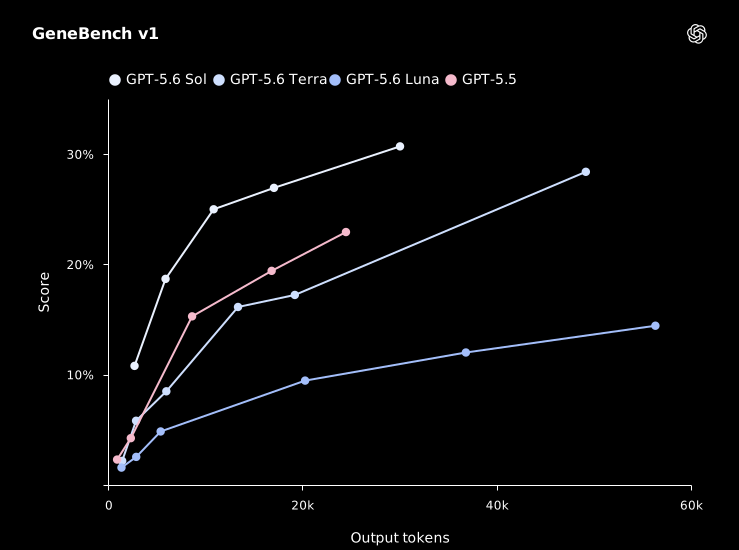 The most obvious difference is price. The Verge reported GPT-5.6 Sol at $5 per million input tokens and $30 per million output tokens. Claude Fable 5 is reported at $10 per million input tokens and $50 per million output tokens.
That gives Sol the cleaner cost story on paper. But agent work is not priced like a single chat answer. An agent can produce plans, diffs, logs, test summaries, retries, and final reports. Output tokens often dominate.
Use this cost lens:
- Token price: input, output, cache, and any premium mode pricing.
- Completion rate: whether the task finishes without human rescue.
- Retry cost: failed commands, repeated analysis, abandoned patches.
- Review time: how much cleanup remains after the model stops.
- Availability risk: whether the model can be used tomorrow under the same conditions.
For coding, the coding agent use case is a practical way to think about this. The model is only one layer; the agent also needs repositories, terminal access, tests, logs, permissions, and a place to keep working.
Which Model Is Better for Coding, Research, and Agents?
The right model changes with the task. GPT-5.6 Sol and Fable 5 may both be strong, but they are not interchangeable if your workflow depends on tooling, policy, latency, or continuity.
Coding Workflows
Use Sol first when OpenAI access is available and the job needs frontier reasoning: hard debugging, security analysis, repo-wide planning, or technical decisions before editing.
Use Fable 5 first for Claude Code-style iteration: reading a project, editing multiple files, running checks, and keeping context across a longer development loop.
If you want a more structured coding setup, the Coding Agent skill is a useful example of turning model capability into delegated background work instead of one-off chat responses.
Research and Analysis
For research, the deciding factors are source handling, long-context discipline, citation quality, and how well the model separates evidence from speculation. Sol may be better for difficult reasoning. Fable 5 may be better for documents, screenshots, or long-form synthesis.
Do not judge this with "summarize this topic." Use a real task: collect sources, build an evidence table, identify contradictions, and write a memo.
Always-On AI Agents
For agents, the model is not the whole product. A useful agent needs files, tools, browser actions, schedules, memory, logs, recovery, and fallback behavior.
This is where the comparison becomes less like a horse race and more like workflow design. The best model is the one that finishes the task with the least cleanup in the environment where the task actually runs.
Run the Same Test in a Real Agent Workspace
 The cleanest comparison is simple: give both models the same job, files, tools, and definition of done.
MyClaw hosts private OpenClaw and Hermes-style agent workspaces with always-on runtime, files, tools, sessions, and model-ready workflows. That makes the comparison practical: you can see which model completes the work.
Step 1: Pick One Job, Not Ten Prompts
Choose a real task: refactor a repo, create a competitor brief, triage support issues, scrape pages, or turn documents into a decision memo.
Step 2: Run the Same Workflow With the Best Available Model
Keep the instructions, files, tools, and success criteria identical. If Sol is available, test it. If Fable 5 is available, test it. If one is restricted, use the closest supported model and note what changed.
Step 3: Preserve the Work So You Can Switch Models
Keep sessions, notes, logs, files, and results in the same workspace so the work can continue if model access changes.
The Smart Choice Is a Model Strategy, Not a Model Bet
The safest answer is not "pick one forever." Use a small model strategy:
- Primary model: the strongest available model for the hardest reasoning step.
- Backup model: a cheaper or more available model for summaries, continuation, and lower-risk work.
- Workflow memory: files, notes, task state, and logs.
- Evaluation set: three to five tasks you run repeatedly.
- Cost check: output cost, retries, latency, and human review time.
That strategy protects you from the part of AI that changes fastest: model access. If the workflow is stable, you can swap the model without rebuilding the whole process.
Bottom Line: GPT-5.6 Sol vs Fable 5
GPT-5.6 Sol vs Fable 5 comes down to four practical questions: which model is available, which one costs less for your task, which one performs better in your real workflow, and which one can keep working inside your agent stack.
Sol may win on reported price, max/ultra modes, and OpenAI frontier positioning. Fable 5 may win for Claude Code-style development, vision-heavy knowledge work, and safeguarded long-horizon tasks. But for one-off reasoning, compare the model. For real agent work, compare the completed workflow.
Some comparisons shorten the topic to GPT-5.6 Sol vs Fable, but the answer is the same: choose the best model you can actually use, keep a fallback, and measure completed work instead of launch-day excitement.
Skip the Setup, Run Best-in-Class AI Agents Now
Launch a managed OpenClaw or Hermes Agent workspace in minutes, with always-on hosting, updates, and support handled by MyClaw.
Get Started