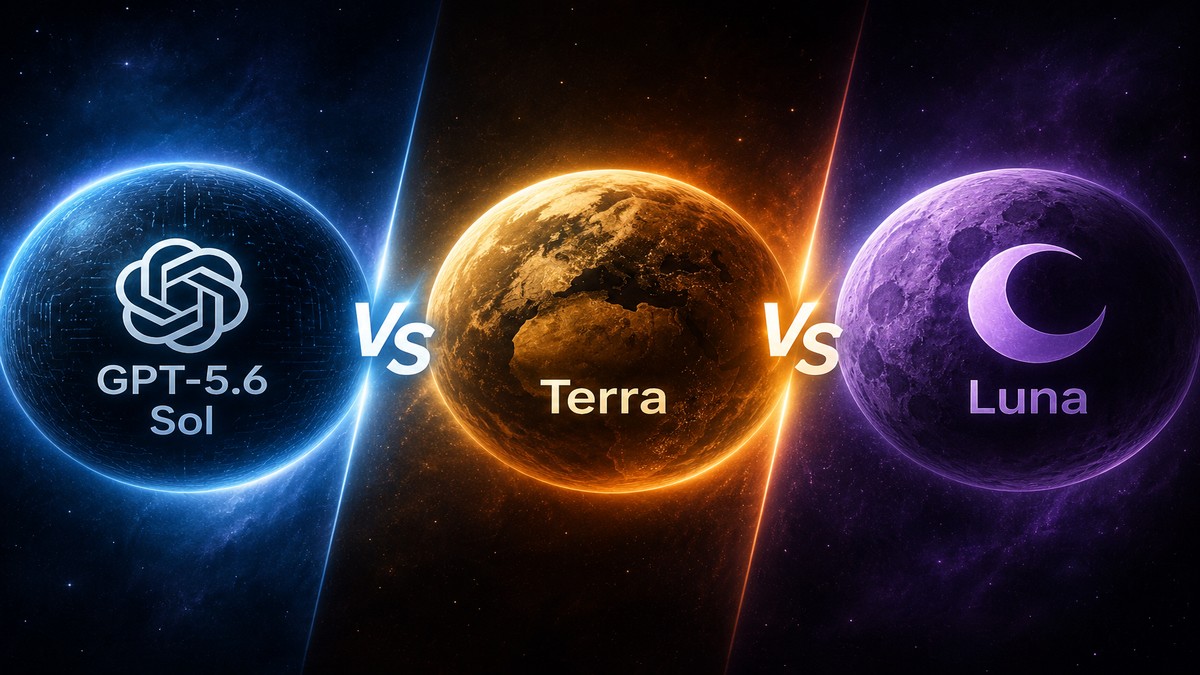
GPT-5.6 Sol vs Terra vs Luna: Which Model Should You Use?

By Olivia Hart
MyClaw Editorial
Compare in MyClaw
Try the GPT-5.6 family yourself
Run the same prompt with Sol, Terra, and Luna to see which balance of depth, speed, and cost fits your work.
AI Takeaway
- GPT-5.6 Sol is the top-tier option for the hardest work: security review, deep coding, scientific reasoning, long-horizon agents, and high-risk decisions.
- GPT-5.6 Terra is the practical default for most professional workflows: strong enough for coding, research, operations, and multi-step automation without spending Sol-level budget on every request.
- GPT-5.6 Luna is the high-volume layer for routing, summaries, tagging, monitoring, simple browser tasks, and repeatable background work.
- Access is still the first constraint. Current public reporting describes GPT-5.6 as a limited preview, not a model family that every developer can freely use today.
- For agents, the best setup is model routing. Let Luna prepare and monitor, let Terra execute most work, and let Sol handle escalation and final judgment.
What Is Actually Known About GPT-5.6
GPT-5.6 Sol vs Terra vs Luna is not just a branding question. Current reporting describes GPT-5.6 as a three-tier model family with controlled rollout, stronger agentic capability, and special attention from U.S. government reviewers because of its potential cybersecurity impact.
That caveat matters. Public details are still limited, and OpenAI's own evergreen model docs may lag behind the news cycle. Treat exact availability, API access, and production limits as moving targets until OpenAI publishes stable developer documentation.
Access Is Limited
Axios reported that OpenAI began with a limited preview for a small group of companies after consultation with the Trump administration. That means the first question is not only "which model is best?" It is also "can my team use it yet, and under what limits?"
If you are planning a production workflow, build it so models can be swapped. A good agent stack should survive preview limits, rate limits, pricing changes, or a delayed public launch.
Pricing Changes the Decision
The Verge reported API pricing for Sol at $5 per million input tokens and $30 per million output tokens, with Terra around half that and Luna less than half of Terra. Those numbers make the tiering easy to understand: Sol is not the model you casually run for every small task.
Pricing also makes this comparison more useful than a normal benchmark discussion. A chat session may only cost a little more on a stronger model. A persistent agent can run many tool calls, retries, summaries, file reads, and browser actions. The wrong default model can quietly turn into a budget problem.
Quick Comparison: Sol, Terra, and Luna
Think of the three models as an operating stack: Sol for depth, Terra for balanced execution, Luna for scale.
| Model | Best For | Main Tradeoff | Practical Use |
|---|---|---|---|
| GPT-5.6 Sol | Security review, hard coding, complex reasoning, scientific work, high-stakes agent decisions | Highest cost and tightest access | Use when accuracy and judgment matter more than price |
| GPT-5.6 Terra | Daily coding, research, operations, technical writing, multi-step automation | Less extreme than Sol | Use as the default workhorse for serious tasks |
| GPT-5.6 Luna | Summaries, monitoring, routing, tagging, repeatable browser or data tasks | Less suited for hard reasoning | Use for high-volume background work |
The short version: start with the cheapest model that can complete the task reliably. Move up only when the work needs deeper reasoning, longer context, better tool use, or more careful judgment. If you already compare models by workflow rather than hype, the MyClaw models page is a useful way to think about availability, production fit, and agent use cases side by side.
Which GPT-5.6 Model Should You Choose?
The right choice depends on the cost of failure. Ask what happens if the model is slow, expensive, or wrong.
Choose Sol When Mistakes Are Expensive
Use Sol for work where a weak answer creates real downstream cost: vulnerability assessment, production incident analysis, large codebase refactors, architecture reviews, scientific reasoning, or any task where the model has to hold many constraints at once.
Sol also makes sense as the reviewer in a model chain. Luna can collect and organize evidence. Terra can draft the plan. Sol can review the final decision before code ships, a report goes out, or a high-risk workflow runs.
For software-heavy workflows, this maps naturally to coding agents. A useful coding agent has to read files, make changes, run commands, inspect failures, and try again. MyClaw's coding agent use case shows how model reasoning becomes real execution rather than another chat answer.
Choose Terra for Most Daily Work
Terra is the sensible starting point for professional workflows. Use it for research briefs, implementation plans, support macros, internal documentation, spreadsheet cleanup, competitive analysis, and routine coding.
It is also the model to test first when the task needs judgment but not maximum reasoning. If Terra completes the work cleanly and consistently, there is no reason to spend Sol-level budget.
Choose Luna for Speed and Repetition
Luna belongs in the background. It can watch, sort, summarize, classify, and prepare work for stronger models.
For example, Luna can monitor competitor pages and summarize changes. Terra can decide what those changes mean. Sol can step in only if the change affects pricing, positioning, or a major technical decision. That layered setup is useful in competitor monitoring, where most changes are routine but a few deserve deeper analysis.
Cost Matters More for Agents Than Chat
A normal chat ends when you stop typing. An agent keeps moving. It may use dozens of prompts, tool calls, retries, file reads, browser actions, and summaries before it finishes.
That is why the best GPT-5.6 setup is not "always use Sol." It is task routing.
A Practical Routing Pattern
- Luna handles monitoring, triage, summaries, labels, and simple routing.
- Terra handles the main execution path: planning, drafting, coding, research, and tool-heavy work.
- Sol handles escalation: security review, final judgment, high-risk changes, and difficult reasoning.
This is the same mental model teams use with humans. Not every task needs a senior reviewer, but the hardest decisions should have one.
Measure Completed Work, Not Raw Intelligence
The cheapest model is not cheaper if it fails often. The strongest model is not better if it is slow, limited, or unnecessary.
For agents, the useful metric is completed work per dollar: tool success, retry rate, latency, context handling, and whether the model stays on task after several steps. That is why runtime matters too. The breakdown of Hermes Agent vs Claude Code is useful because it separates the model question from the runtime question. The model decides how the agent thinks. The runtime decides where and how the agent works.
Turn Better Models Into Better Workflows
 When GPT-5.6 access becomes broader, the biggest upgrade will not be a nicer chatbot. It will be stronger models working inside persistent environments: files, tools, browser sessions, logs, memory, and scheduled jobs.
That is where MyClaw fits naturally. It gives an AI agent a hosted workspace so the model can keep working after a normal chat would stop. Instead of picking Sol, Terra, or Luna in isolation, you can decide what each model should do inside an always-on workflow.
Step 1: Start With the Job
Name the actual job before choosing a model: review a pull request, monitor a competitor, prepare a weekly SEO brief, clean a dataset, answer support tickets, or research a market. Then decide how much reasoning and risk control the job needs.
Run the same prompt with Sol, Terra, and Luna to see which balance of depth, speed, and cost fits your work.
Step 2: Give the Agent a Real Workspace
Put the workflow somewhere persistent, with access to tools, files, browser actions, logs, and scheduled runs. A stronger model is more useful when it can act, check its work, and continue from context.
Step 3: Route Easy Work Down and Hard Work Up
Do not spend Sol-level reasoning on every small task. Let a lighter model prepare inputs, let a balanced model do most of the work, and escalate only difficult decisions.
Compare GPT-5.6 Against the Full Model Stack
GPT-5.6 will be compared against Claude, Gemini, DeepSeek, GLM, MiniMax, Qwen, Grok, and other models that may be better for specific workloads or easier to access.
The right comparison is not "which brand wins?" It is:
- Which model handles long context best?
- Which model is reliable with tools?
- Which model is affordable for repeated tasks?
- Which model is available through the channels you actually use?
- Which model works well as part of a multi-model routing strategy?
This is especially true for specialized workflows. A content or SEO agent might care less about pure coding benchmarks and more about browsing, research quality, page comparison, and structured output. A skill like SEO AEO keyword research is a good example: the model matters, but the repeatable workflow around the model matters just as much.
The Best Choice
For most workflows, Terra is the safest starting point. It should be strong enough for serious daily work without sending every task to the most expensive model.
Sol should be reserved for the moments where judgment is the product: security, architecture, high-stakes code, complex research, and final review. Luna should run the repetitive layer: summaries, checks, routing, monitoring, and simple automation.
So the best answer is not really Sol vs Terra vs Luna. It is Sol plus Terra plus Luna, used deliberately. Put routine work on the fast layer, everyday execution on the balanced layer, and hard calls on the strongest layer. That is how GPT-5.6 becomes more than a model announcement. It becomes a practical system for getting better work done.
Compare in MyClaw
Try the GPT-5.6 family yourself
Run the same prompt with Sol, Terra, and Luna to see which balance of depth, speed, and cost fits your work.