Kimi K2.6 vs GLM-5.1: Coding, Reasoning, Agents

By Emma Reed
MyClaw Editorial
MyClaw
Run Best-in-Class AI Agents Now
Run OpenClaw or Hermes Agent on managed MyClaw hosting, so your AI agent stays online, updated, and ready for real work.
AI Takeaway
- Coding: Kimi K2.6 has the cleaner open-model story and a tiny published edge on SWE-Bench Pro: 58.6 vs GLM-5.1's 58.4. GLM-5.1 is close, but its pitch is more about sustained engineering work than one-shot coding.
- Reasoning: Kimi K2.6 looks stronger on several hard reasoning benchmarks, including GPQA-Diamond. GLM-5.1 is more interesting when reasoning has to survive a long tool loop.
- Agents: Kimi K2.6 is attractive for open agentic coding experiments. GLM-5.1 is compelling for long-running engineering sessions with repeated terminal and benchmark feedback.
- Best way to choose: Do not pick from a benchmark table alone. Run both models on the same repo, same tools, same budget, and judge completed work.
Quick Verdict: Kimi K2.6 vs GLM-5.1
Kimi K2.6 vs GLM-5.1 is not a clean "winner takes all" comparison. The models overlap in coding, reasoning, and agent tasks, but they feel aimed at different workflows.
Kimi K2.6 is the easier first pick if you want a strong open model for agentic coding, tool use, front-end work, codebase exploration, and multi-agent experiments.
GLM-5.1 is the model to take seriously if your work looks less like "write this function" and more like "keep improving this project for hours."
If you are already comparing agent tools, the same distinction shows up in broader coding-agent discussions like Hermes Agent vs Claude Code: the model matters, but the surrounding workflow decides how much of that model capability turns into shipped work.
Kimi K2.6 vs GLM-5.1 at a Glance
| Category | Kimi K2.6 | GLM-5.1 | Practical Meaning |
|---|---|---|---|
| Core angle | Open, agentic coding model | Long-horizon engineering model | Kimi is better for open experimentation; GLM is better for sustained engineering loops |
| Coding | Very strong published coding scores | Very strong coding and terminal positioning | Both deserve testing on real repos |
| Reasoning | Strong hard-reasoning benchmark profile | Strong planning and execution emphasis | Kimi may win isolated reasoning; GLM may hold up in long loops |
| Agent use | Proactive agents, swarms, tool execution | Autonomous engineering, OpenClaw-style work | Choose based on task length and tool depth |
| First test | Multi-file code task with tool calls | Long debugging or optimization task | The right test is a completed task, not a prompt answer |
The trap is treating the table as the decision. Coding agents live inside repos, terminals, browsers, files, logs, and messy follow-up errors.
Coding: Which Model Handles Development Work Better?
Benchmark Signals That Matter
For coding, the most useful signals are SWE-Bench Pro, SWE-Bench Verified, Terminal-Bench, LiveCodeBench, and multilingual software engineering tasks. Kimi K2.6 reports 58.6 on SWE-Bench Pro, 80.2 on SWE-Bench Verified, and 89.6 on LiveCodeBench v6, making it a serious choice for code generation, bug fixing, and multi-file edits.
 GLM-5.1 is close enough that it should not be dismissed: Z.AI reports 58.4 on SWE-Bench Pro and 63.5 on Terminal-Bench 2.0. Its positioning leans into repo generation, terminal work, structured tool use, and long autonomous sessions.
Repo Work Is Not Code Snippets
The real coding test is whether a model can enter an existing codebase and avoid changes that create more review work than they remove.
Compare both models on:
- understanding existing architecture
- editing the smallest necessary set of files
- writing tests that match local style
- recovering after failing test output
- explaining tradeoffs without bloating the patch
- avoiding broad rewrites when a small fix is enough
If your goal is a persistent coding workflow, start with a realistic scenario like the coding agents use case: pull request review, test generation, failed build triage, and routine repo maintenance.
Cost per Accepted Patch
The model with the highest benchmark score is not always the cheapest model to use. The better business metric is cost per accepted patch.
A good coding model should finish with fewer abandoned attempts, irrelevant edits, manual corrections, and "almost right" patches. If you want focused capabilities instead of a loose toolbox, a coding-focused skill such as Coding Agent makes model comparison more meaningful.
Reasoning: Which Model Thinks Better Under Pressure?
Hard Questions vs Long Tasks
Kimi K2.6 appears stronger if you define reasoning as hard benchmark performance: math, knowledge, GPQA-style questions, AIME-style problems, and broad evaluation suites. Its reported GPQA-Diamond score is 90.5, compared with GLM-5.1's 86.2.
GLM-5.1 becomes more interesting when reasoning means staying useful across a long chain of actions: plan, call a tool, read output, notice a mismatch, change direction, and keep going.
Agent Reasoning Is Behavioral
In an agent workflow, reasoning is visible through behavior:
- Does the model call the right tool?
- Does it notice when the output contradicts its plan?
- Does it stop before changing too much?
- Does it keep track of what has already been tried?
- Does it ask for missing information only when it really needs it?
Kimi K2.6 has the stronger benchmark-heavy reasoning story. GLM-5.1 has a strong case when the task requires patience, iteration, and engineering discipline.
Long-Horizon Agents Are the Real Test
Kimi K2.6 for Open Agent Experiments
Kimi K2.6 is especially interesting if you want an open model for agentic coding. Its positioning around proactive agents, long-horizon coding, tool use, and agent swarms gives it a flexible builder feel.
It is a good first test for:
- exploring a large codebase
- generating and refining front-end features
- running several smaller coding tasks in parallel
- combining search, files, terminal commands, and code edits
- experimenting with multi-agent patterns
GLM-5.1 for Sustained Engineering Loops
GLM-5.1's most interesting promise is endurance. Z.AI positions it around autonomous tasks that can run for up to 8 hours, so it is worth testing on work where the first answer is rarely enough.
Good tests include debugging a failing build, optimizing a benchmark target, improving a repo scaffold, or handling a terminal-heavy task that takes repeated inspection.
The Harness Can Change the Result
An agent is not just a model. It is a runtime with memory, files, terminal access, browser access, permissions, logs, retry rules, and monitoring. That surrounding system can change which model wins.
Production data from a real environment, such as the OpenClaw AI model benchmark, helps shift attention from leaderboard scores to latency, cost, reliability, and usage patterns.
How to Choose Between Kimi K2.6 and GLM-5.1
Choose Kimi K2.6 If
- you want a strong open-model strategy
- your tasks involve coding, front-end work, and tool-heavy exploration
- you care about long-context codebase understanding
- you want to experiment with agent swarms or proactive agents
Choose GLM-5.1 If
- your tasks are long, iterative, and engineering-heavy
- you care about terminal work and repeated benchmark feedback
- you want a model that keeps executing instead of giving one polished answer
- you need structured output, function calling, and tool discipline
Test Both Before Committing
Use the same repo issue, tool permissions, time budget, and evaluation rules. Ask both models to make the patch, run tests, explain the fix, and stop when the task is complete. Then compare:
- accepted patch rate
- test pass rate
- total cost
- number of tool calls
- review effort
- how often the model gets stuck
That gives you a better answer than any public chart.
Testing Both in a Real Agent Workspace
The cleanest way to compare Kimi K2.6 and GLM-5.1 is to put them inside the kind of agent workflow you actually plan to use. A chat window is too shallow. A coding agent needs files, tools, shell access, remote availability, and enough continuity to finish after the first attempt fails.
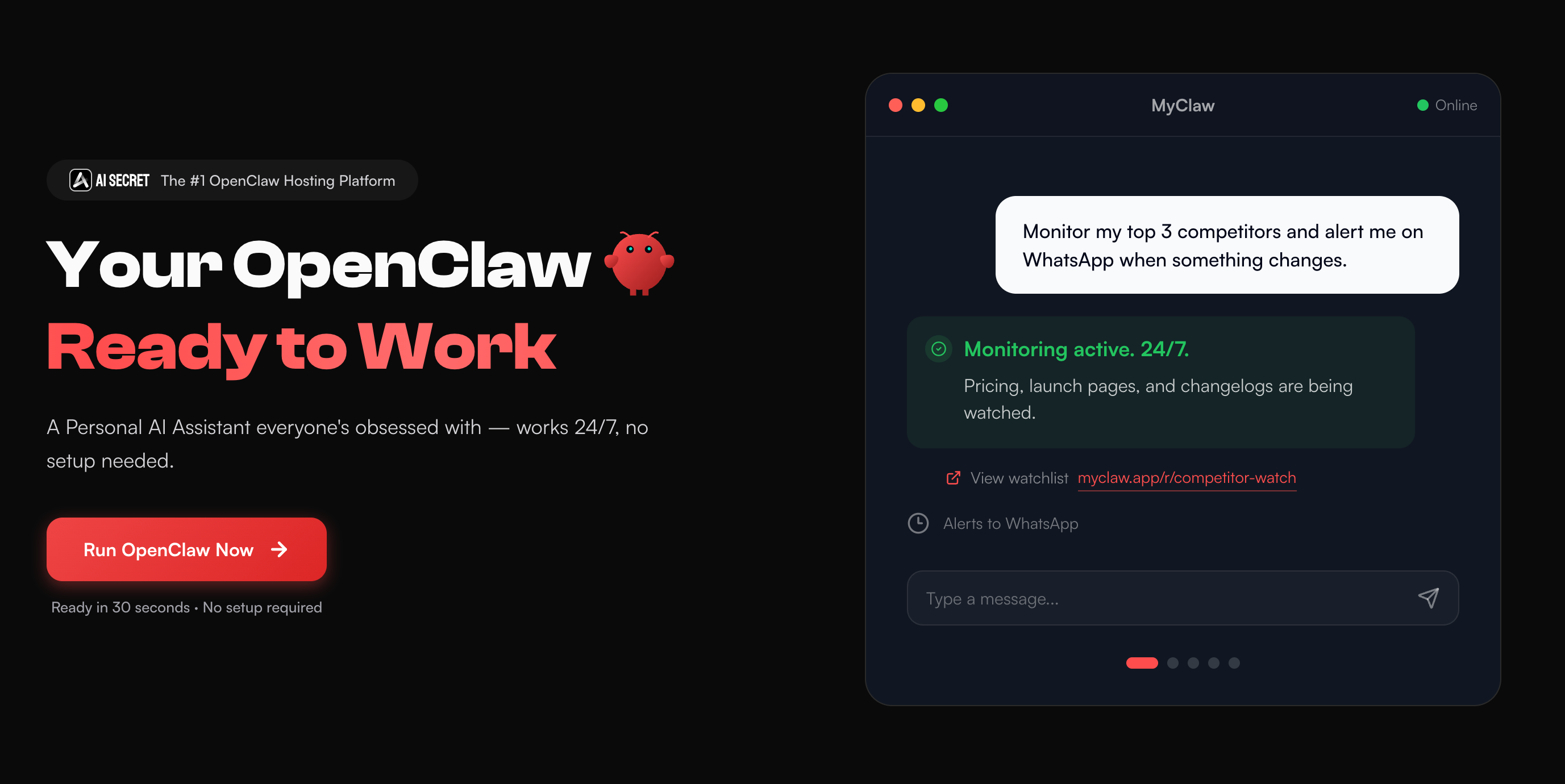 MyClaw gives you a hosted OpenClaw environment for that kind of test. Instead of setting up servers, Docker, updates, remote access, and uptime yourself, you can run an isolated OpenClaw instance, connect model access, and compare models on real coding, research, and automation tasks.
A simple test plan:
- Pick one real repo issue.
- Give both models the same task and tool access.
- Let each model run with the same time and token budget.
- Compare patch quality, tests, runtime errors, and review effort.
- Repeat across coding, reasoning, and scheduled agent tasks.
Conclusion
Kimi K2.6 vs GLM-5.1 is not a simple model ranking. Kimi K2.6 is a strong first choice for open coding and tool-heavy experimentation. GLM-5.1 is a serious option for long-horizon engineering tasks.
If the model will power an OpenClaw or coding agent, compare them in a real runtime with the same tools, budget, and tasks. That is where the difference becomes useful: not which model sounds better, but which one gets more real work done.
Skip the Setup, Run Best-in-Class AI Agents Now
Launch a managed OpenClaw or Hermes Agent workspace in minutes, with always-on hosting, updates, and support handled by MyClaw.