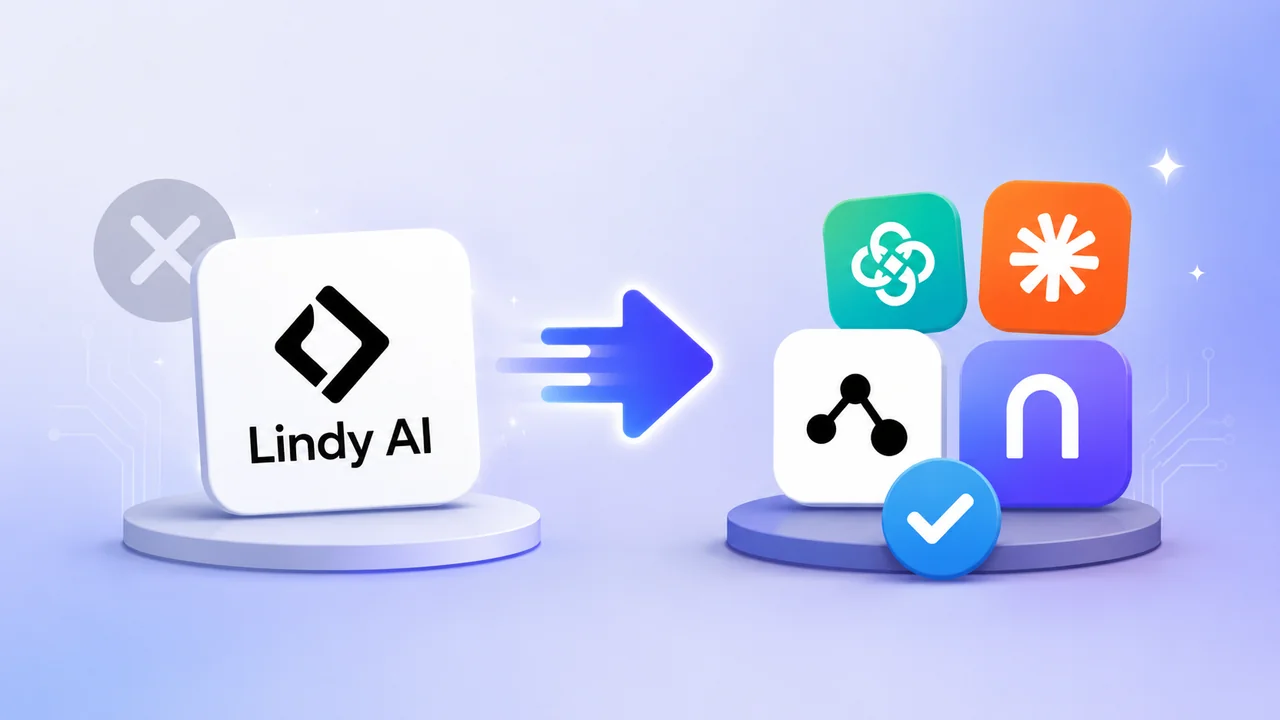
Best Lindy AI Alternative: Open-Source and Managed Options

By Julian Brooks
MyClaw Editorial
MyClaw
Run Best-in-Class AI Agents Now
Run OpenClaw or Hermes Agent on managed MyClaw hosting, so your AI agent stays online, updated, and ready for real work.
AI Takeaway
- Best overall Lindy AI alternative: MyClaw is the strongest choice if you want a private OpenClaw assistant without running your own server.
- Best fully open-source path: OpenClaw gives you maximum control, but setup, updates, security, and uptime stay on your side.
- Best workflow automation options: n8n and Activepieces are better for visual app-to-app automation than for executive assistance.
- Best AI app builders: Dify and Flowise fit teams building chatbots, RAG apps, internal assistants, and agent workflows.
- Best hosted business-agent tools: Zapier Agents, Gumloop, Relevance AI, and Bardeen are useful for sales, support, research, and lead workflows.
Lindy Is Good, but the Best Alternative Depends on What You Want
Lindy is a polished AI executive assistant. It is strongest for daily admin: sorting email, drafting replies, scheduling meetings, taking notes, sending follow-ups, and keeping your calendar manageable.
The decision gets more interesting when you want the assistant to be more yours: open-source foundations, private runtime, broader tool access, or workflows beyond one vendor's product shape.
The better Lindy alternatives usually fall into three groups:
- AI executive assistants that feel ready-made and polished.
- Workflow automation builders that connect apps and automate repeatable processes.
- Agent runtimes that give an AI assistant a place to live, act, remember, and keep working.
The right choice depends on the kind of work you want to hand off.
Best Lindy AI Alternatives at a Glance
| Tool | Best For | Open Source | Hosted Option | Main Tradeoff |
|---|---|---|---|---|
| MyClaw | Managed private OpenClaw assistant | Open-source foundation | Yes | Less DIY control than self-hosting |
| OpenClaw | Full control over a personal AI assistant | Yes | Self-managed | Setup and security are on you |
| n8n | Visual workflow automation | Source-available/open ecosystem | Yes | More workflow builder than assistant |
| Activepieces | Team-friendly automation | Yes | Yes | Less personal-assistant focused |
| Dify | AI apps and agentic workflows | Yes | Yes | More builder than daily assistant |
| Flowise | Visual LLM workflows | Yes | Yes | Better for prototypes and AI flows |
| Zapier Agents | App-connected business agents | No | Yes | Closed hosted platform |
| Gumloop | Team-built AI agents | No | Yes | Stronger for business ops than personal use |
| Relevance AI | Specialist enterprise agents | No | Yes | Enterprise-oriented |
| Bardeen | Browser scraping and lead workflows | No | Yes | Narrower GTM focus |
1. MyClaw: Best Lindy AI Alternative for a Private Open-Source AI Assistant
MyClaw is the best starting point if you like Lindy but want a more open, private assistant layer underneath. Instead of asking you to clone a repo, configure a server, expose a gateway, and keep the stack alive, MyClaw gives you a managed OpenClaw instance.
The hard part is rarely imagining what an AI assistant could do. The hard part is keeping it available and useful after the first demo. MyClaw handles the hosted runtime, isolation, updates, and access path.
It fits if you want an AI assistant that can grow beyond email and meetings into research, browser work, summaries, file tasks, monitoring, and recurring workflows.
Why MyClaw Stands Out
MyClaw sits in a useful middle ground. Lindy is convenient but closed. OpenClaw is powerful but technical. MyClaw keeps the OpenClaw direction without the setup gap.
You get:
- A dedicated assistant environment.
- Always-on hosting.
- Private isolation.
- OpenClaw-compatible skills and channels.
- A practical path from personal workflows to team rollout.
The result feels less like a single-purpose assistant and more like a private AI workspace that keeps working in the background.
How to Use MyClaw in 3 Steps
Step 1: Launch Your Private Assistant
Pick a plan and start your dedicated OpenClaw instance. The first win is simple: a running assistant, not an afternoon of terminal setup.
Step 2: Connect One Real Workflow
Start narrow. Connect the tools for one job: Gmail and calendar for daily admin, Slack and Notion for team follow-ups, or browser access for research.
Step 3: Give It a Weekly Responsibility
Ask it to own one recurring outcome: prepare Monday meeting briefs, summarize important email, monitor competitor updates, draft follow-ups, or keep a project status doc fresh. Once that works, add the next responsibility.
2. OpenClaw: Best for Full Open-Source Control
OpenClaw is the closest conceptual alternative to Lindy if you want a true open-source personal AI assistant. It can run locally, connect through messaging channels, use skills, and behave like a persistent assistant. For more background, start with this guide on what OpenClaw is.
The appeal is control. You choose where it runs, which models it uses, which tools it can access, and how far it is allowed to go.
Full control means full responsibility. You manage setup, updates, logs, credentials, security, channel configuration, model choices, and downtime. That is satisfying if you like owning the system, and frustrating if you mainly want availability.
Choose OpenClaw directly if you are comfortable operating your own assistant runtime. Choose a managed route if your priority is getting useful work done quickly.
3. n8n and Activepieces: Best for Workflow Automation
n8n and Activepieces are better alternatives when the real job is workflow automation. They shine when work can be described as a sequence: when this happens, check that, transform data, send it, alert someone, and log the result.
They are useful for:
- Lead routing.
- CRM updates.
- Support ticket enrichment.
- Internal ops workflows.
- Reporting and alerts.
- Marketing and sales handoffs.
- AI steps inside a predictable process.
If email is the center of your workflow, an assistant and an automation builder can overlap. A team might use an email automation agent for triage, follow-up logic, and routing outcomes into CRM or support.
The main difference is assistant versus process. Lindy and MyClaw feel like places where you hand off work. n8n and Activepieces feel like control panels for processes you design.
Choose n8n or Activepieces for transparent workflows, visual debugging, and repeatable automation. Choose an assistant runtime if you want something you can message and delegate to.
4. Dify and Flowise: Best for AI Apps and Agent Workflows
Dify and Flowise are not direct executive assistant replacements. They are better for building AI products and internal tools: chatbots, RAG apps, knowledge-base assistants, model workflows, and agent chains.
They are a good fit when the question sounds like:
- Can we build an internal support assistant?
- Can we connect a knowledge base to a chatbot?
- Can we test model workflows visually?
- Can we prototype an agent before engineering builds it into the product?
Model choice matters here because workflow quality depends on reasoning, context, tool use, and cost. If you are comparing models for agent work, Claude Sonnet 5 is the kind of model-level reference worth checking before you commit.
The tradeoff is that Dify and Flowise ask you to think like a builder. You design flows, prompts, tools, retrieval, and deployment. That is powerful, but it is different from asking an assistant to manage your week.
Choose Dify or Flowise if your goal is to build AI systems. Choose MyClaw or OpenClaw if your goal is to use an AI assistant that already has a place to run.
5. Zapier Agents, Gumloop, Relevance AI, and Bardeen: Best Hosted Business-Agent Options

Hosted business-agent tools are strong if your work is tied to revenue operations, sales, support, recruiting, research, or lead generation.
Zapier Agents has Zapier's huge integration ecosystem. Gumloop is built around teams creating agents for work. Relevance AI leans into specialist enterprise agents. Bardeen is strong around browser automation, scraping, lead sourcing, and enrichment.
These tools can be right when speed and polished templates matter more than open-source control. They speak the language of CRM updates, lead qualification, support queues, research packets, and outbound workflows.
The tradeoff is ownership. You usually get a hosted platform, not a runtime you control. For a broader view, Hermes Agent vs Claude Code separates agent roles instead of treating every AI tool as the same thing.
Choose these platforms for business-agent workflows with less setup. Look elsewhere if open source, private deployment, or runtime ownership is the core requirement.
How to Choose the Right Lindy AI Alternative
Start with the work, not the tool list.
If you want a private assistant that can become part of your daily rhythm, choose MyClaw. It is the best fit when you want the OpenClaw direction without hosting it yourself.
If you want full control and are comfortable with technical setup, choose OpenClaw directly.
If you want to automate structured processes across apps, choose n8n or Activepieces.
If you want to build AI apps, chatbots, or RAG workflows, choose Dify or Flowise.
If you want polished business agents for sales, support, research, or recruiting, choose Zapier Agents, Gumloop, Relevance AI, or Bardeen.
For a practical first workflow, start with communication. A Gmail skill can make the assistant useful: reading, searching, drafting, and summarizing email. Once that works, a Proactive Agent skill can help it notice what needs attention before you ask.
The best tool matches your tolerance for control, setup, and delegation. More control usually means more responsibility. More convenience usually means less ownership.
Final Recommendation
If you want the cleanest Lindy alternative for a private assistant with an open-source foundation, start with MyClaw. It gives you the practical benefits of an AI executive assistant - availability, integrations, background work, and simple onboarding - without asking you to operate the infrastructure yourself.
If you want to build everything yourself, OpenClaw is the more flexible path. If you want visual automation, n8n and Activepieces are stronger. If you want to build AI apps, Dify and Flowise make more sense. If you want packaged business agents, the hosted platforms are worth testing.
The real choice is not "which tool has the most features." It is whether you want an assistant, a workflow builder, an AI app platform, or a managed agent runtime. If you want an open-source Lindy AI alternative without the setup burden, MyClaw is the most natural place to begin.
Skip the Setup, Run Best-in-Class AI Agents Now
Launch a managed OpenClaw or Hermes Agent workspace in minutes, with always-on hosting, updates, and support handled by MyClaw.