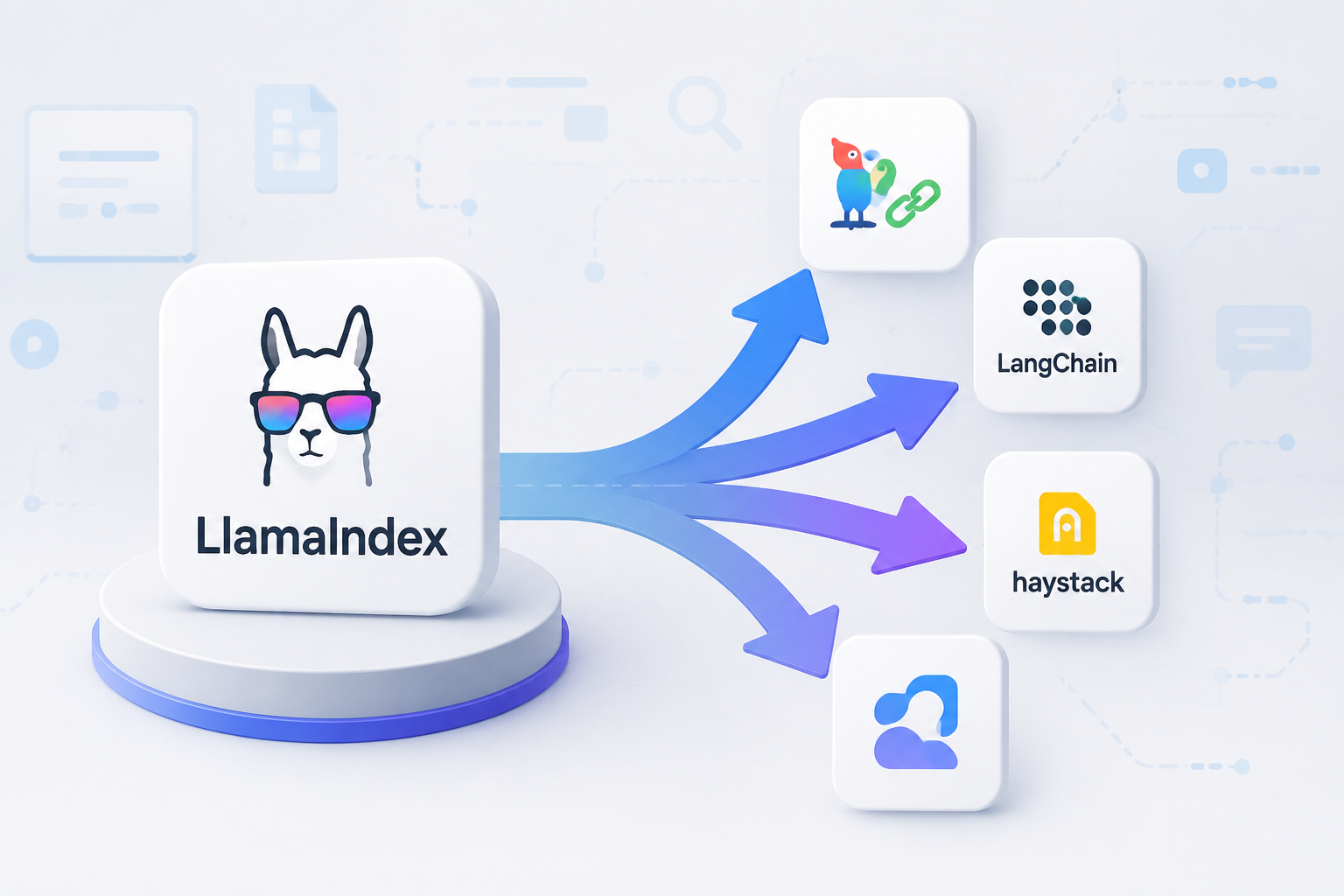
9 LlamaIndex Alternatives in 2026: Free, Open-Source & Managed Options

By Emma Reed
MyClaw Editorial
MyClaw
Run Best-in-Class AI Agents Now
Run OpenClaw or Hermes Agent on managed MyClaw hosting, so your AI agent stays online, updated, and ready for real work.
AI Takeaway
- Need an AI agent doing useful work today? MyClaw is the strongest first choice for a private, always-on agent that can research, monitor, write, and report without asking you to build a RAG stack first.
- Building a custom application? Choose LangChain or LangGraph when retrieval is one part of a wider agent or workflow. Choose Haystack when you want an explicit, production-minded RAG pipeline.
- Trying to improve answer quality rather than add features? DSPy helps optimize prompts and retrieval behavior against examples. It pays off only when you have a good evaluation set.
- Working with changing data or non-developers? Pathway suits continuously updated knowledge. RAGFlow, Dify, and Flowise make the workflow more visible, with different limits on control.
- Should you leave LlamaIndex at all? Not necessarily. It remains a solid retrieval-first choice for document-heavy applications, especially when its connectors and index options already fit the job.
LlamaIndex Alternatives Compared at a Glance
LlamaIndex is built around getting the right context into an LLM. The options below solve different parts of that problem, so they are not interchangeable.
| Alternative | Best for | Type | The tradeoff |
|---|---|---|---|
| MyClaw | An always-on research or operations agent | Managed AI agent workspace | Not an embeddable RAG SDK |
| LangChain / LangGraph | Agents, tools, and custom AI applications | Framework | More architecture to own |
| Haystack | Explicit, testable RAG pipelines | Framework | Python-first workflow |
| DSPy | Optimizing RAG behavior | Framework | Needs evaluation data |
| Pathway | Live, changing knowledge bases | Framework | A more specialized setup |
| RAGFlow | Visual, document-heavy RAG | Open-source platform | Less code-level freedom |
| Dify | Internal AI apps and visible workflows | Low-code platform | Platform constraints |
| Flowise | Fast visual prototyping | Low-code platform | Large flows can become hard to maintain |
| Custom stack | Full control with few abstractions | Build it yourself | You own every production concern |
1. MyClaw: Best for an Always-On AI Agent
Not every AI task needs a RAG API. Sometimes the job is to monitor competitors, turn sources into a weekly brief, or move work between tools that already exist. Building retrieval infrastructure can then become a detour.
MyClaw runs private OpenClaw or Hermes Agent workspaces that stay available after the laptop is closed. It suits work where the deliverable matters more than owning a Python or TypeScript retrieval layer. Hosting, updates, backups, and the persistent runtime are included.
It is not a drop-in SDK; it is for an agent that keeps working across files, tools, channels, and recurring tasks.
Step 1: Start With One Job You Can Judge
Give the agent a clear finish line. “Check these five competitors, flag material changes, and send a source-linked brief” is far more useful than “research the market.”
Step 2: Put the Right Context Within Reach
Connect the relevant files, websites, repositories, or work channels, then choose where the result should arrive: email, Telegram, or the browser workspace.
Step 3: Turn a Good Result Into a Routine
Once the output is dependable, schedule it or save the process as a reusable skill. The payoff is work that still happens next week.
2. LangChain and LangGraph: Best for Full AI Applications
LangChain is the broad choice when retrieval sits alongside tools, agents, memory, and several model providers. LangGraph adds control for stateful workflows with branching, checkpoints, retries, approvals, or long-running execution.
That flexibility creates real design work. Choose it when the complexity belongs in the product, not because a graph looks sophisticated.
For implementation-focused work, a reusable coding agent skill is a useful way to turn a repository task into a concrete plan, review, or fix. The model decision is separate from the framework decision; this recent comparison of Gemma 4 and Claude Opus 4.6 is a good reminder that the best model depends on the job as much as the stack does.
3. Haystack: Best for Explicit Production RAG Pipelines
Haystack works well when every step should be visible: prepare documents, retrieve candidates, rerank them, generate an answer, and return citations or structured output. Its component model makes individual pieces easier to replace.
If an answer is weak, the team can isolate parsing, chunking, retrieval, ranking, or generation instead of treating the system as a black box. It is strongest when maintainability matters more than a fast first demo.
4. DSPy: Best for Optimizing Retrieval and Prompts
DSPy takes a different approach. Rather than hand-tuning every prompt, it treats prompts, examples, and pipeline behavior as parameters that can be improved against a training or evaluation set. That can be valuable for a support assistant, research workflow, or extraction task that has enough real examples to measure success.
Do not choose DSPy just to make a prototype feel advanced. Without representative questions and clear scoring, there is nothing meaningful to optimize. A strong reasoning model can help once the evaluation process is sound; the Claude Sonnet 5 model page is a useful reference when comparing a model for structured, tool-using work.
5. Pathway: Best for Continuously Changing Data
Many knowledge bases are not really databases of static PDFs. They are feeds, product catalogs, support tickets, event streams, and documents that change every day. Pathway is a better fit when fresh information should become searchable quickly rather than waiting for a periodic re-index.
The tradeoff is operational. Streaming data introduces questions about duplicates, deletes, late updates, and what should happen when an upstream source fails. Use it when freshness changes the quality of the answer, not merely because real-time architecture sounds attractive.
6. RAGFlow, Dify, and Flowise: Best for Visible Workflows
Visual platforms can make an AI workflow easier to inspect, share, and change. They are especially helpful when domain experts need to participate without editing a codebase. Their differences matter, though.
RAGFlow: Best for Document-Heavy Projects
RAGFlow is useful when document parsing and retrieval need a visible home. It can speed up pilots with complex PDFs and business documents. Deeply customized products still need tests, version control, and deployment discipline.
Dify: Best for Deployable Internal Apps
Dify works well for teams assembling prompts, knowledge sources, and an internal interface without an empty repository. The limit appears when custom logic, permissions, or integrations become the product.
Flowise: Best for Fast Experiments
Flowise offers a node-based way to try LLM chains, agents, and retrieval flows quickly. It is good for small workflows with a clear owner. As the canvas grows, debugging can become harder than reading code.
7. Build a Custom RAG Stack: Best for Maximum Control
Sometimes the cleanest solution is no orchestration framework at all. A focused product may only need a parser, embeddings, a vector store, a retriever, a reranker, and an LLM API.
Someone still owns ingestion failures, permissions, observability, evaluation, retries, and recovery. A self-managed model can be part of that control story; the Gemma 4 model page is a useful starting point for an open-weight option. Build your own stack when those decisions are a competitive advantage.
How to Make the Choice Without Overbuilding
Write down the outcome, the owner, and the cost of a wrong answer. That usually narrows the field quickly.
Choose a Managed Agent for Ongoing Work
Use MyClaw for recurring research, monitoring, reporting, writing, or operations. The research agent use case shows where a persistent agent is more useful than a new service to maintain. The SEO and AEO keyword research skill is another repeatable job with a clear output.
Choose a Code Framework for a Product Feature
Pick LlamaIndex for retrieval-first applications, LangChain or LangGraph for tool-using and stateful systems, and Haystack for explicit production pipelines. DSPy belongs later, when there is enough real traffic or test data to improve the system with evidence.
Choose a Visual Platform for Shared Ownership
Pick RAGFlow, Dify, or Flowise when a visible workflow helps its owners make safe changes. Keep it small, document who owns credentials, and decide how failed runs will be noticed.
Free and Open Source Does Not Mean Zero Cost

Most framework repositories here are free to use and open source, but the license is only one part of the bill. Model inference, embeddings, vector search, parsing, storage, monitoring, security reviews, and engineering time can outweigh the framework. Compare total operating cost over the first few months—not whether pip install was free.
For a custom product, those costs may be worthwhile because they buy control. For an ongoing business workflow, a managed workspace can be less expensive simply because it avoids turning server upkeep, backup plans, and failure recovery into a side project.
Test a Change Before You Migrate
Run the same small set of real documents and questions through both stacks before committing to a migration. Score source correctness, answer completeness, median response time, and the time it takes to diagnose a failed result. A framework that looks cleaner in a tutorial can still lose when it meets your actual data.
Involve the people who will maintain the system. The best choice should improve day-to-day work after launch, not just the demo.
When It Makes Sense to Keep LlamaIndex
There is no prize for migrating away from a working stack. Keep LlamaIndex when the application is fundamentally about document retrieval, its existing connectors and indexing tools meet the need, and the team can measure acceptable answer quality. Switch only when there is a specific constraint to solve: more explicit pipeline control, live data, systematic optimization, a visual editing requirement, or a different product architecture.
Conclusion: Remove the Bottleneck That Actually Matters
The best LlamaIndex alternative is the one that removes the real constraint. LangChain and LangGraph help when an application needs broader agent behavior. Haystack makes production RAG easier to inspect. DSPy improves a system that can be measured. Pathway keeps changing knowledge current, while visual platforms bring more people into the workflow.
And when the goal is simply to get dependable research or operational work done, MyClaw offers a shorter path: a private agent that can keep working after the initial conversation ends. Choose the level of ownership that helps the work move forward—not the one that creates the most infrastructure.
Skip the Setup, Run Best-in-Class AI Agents Now
Launch a managed OpenClaw or Hermes Agent workspace in minutes, with always-on hosting, updates, and support handled by MyClaw.