Gemini 3.1 Pro vs GPT-5.4: Thinking, Coding, and AI Agents

By Olivia Hart
MyClaw Editorial
MyClaw
Run Best-in-Class AI Agents Now
Run OpenClaw or Hermes Agent on managed MyClaw hosting, so your AI agent stays online, updated, and ready for real work.
Start HostingAI Takeaway
- Best overall: GPT-5.4 is the better first choice for complex professional work, coding workflows, computer use, and careful tool-heavy execution.
- Best for big context: Gemini 3.1 Pro is a serious option for long-context, multimodal, Google-native, and agentic coding workflows.
- Best for thinking: GPT-5.4 Thinking is better when the work needs slower reasoning, source synthesis, code review, or high-stakes analysis.
- Best for coding agents: Start with GPT-5.4 for repo-level implementation and verification. Test Gemini 3.1 Pro when the workflow depends on long context or Google tools.
- What matters most: The model is only part of the system. A useful agent also needs files, browser access, tools, memory, approvals, and a stable runtime.
Quick Answer: GPT-5.4 for Precision, Gemini 3.1 Pro for Big Context
If you need a direct choice, start with GPT-5.4 for difficult reasoning, coding, document work, and agents that must use tools carefully. Use Gemini 3.1 Pro when the task depends on large context, multimodal input, or Google’s AI ecosystem.
That does not make Gemini 3.1 Pro a weaker model. It is one of the more interesting choices for long-horizon agent workflows, especially when a task involves code, documents, images, diagrams, or large project context. GPT-5.4 simply feels more reliable when the final answer needs to be precise, verified, and production-ready.
For a deeper model-specific breakdown, the Gemini 3.1 Pro model page is a good companion to this comparison.
| Use Case | Better First Pick | Why |
|---|---|---|
| Deep reasoning | GPT-5.4 | Better for careful thinking and high-stakes analysis |
| Repo-level coding | GPT-5.4 | Better for implementation, debugging, and verification |
| Long-context review | Gemini 3.1 Pro | Better for large files, docs, and mixed context |
| Multimodal tasks | Gemini 3.1 Pro | Better when images, diagrams, PDFs, or video matter |
| Agent workflows | Depends | GPT-5.4 for careful execution; Gemini for broad context |
Thinking: Which Model Handles Hard Reasoning Better?
For hard thinking tasks, GPT-5.4 has the clearer story. It is built for professional work where the model has to reason, revise, check assumptions, and produce something usable with fewer follow-up prompts.
Use GPT-5.4 Thinking When Accuracy Matters
 GPT-5.4 Thinking is the better pick when a fast answer is not enough. Examples include security-minded code review, legal or policy analysis, technical troubleshooting, financial modeling, source-heavy research, and any task where a confident but wrong answer would cost time.
Its advantage is not just that it can reason longer. The bigger advantage is that the reasoning connects well with coding, tool use, documents, spreadsheets, and computer-use workflows. That makes GPT-5.4 especially useful when the task starts as analysis but ends as action.
Use Gemini 3.1 Pro When the Context Is the Hard Part
 Gemini 3.1 Pro becomes more attractive when the challenge is not only reasoning, but absorbing a large messy input: long PDFs, large codebases, product specs, screenshots, diagrams, recorded demos, or Google Workspace material.
The caution is simple: a large context window is not the same as perfect understanding. More room helps, but it does not guarantee that the model will retrieve the right detail or weigh it correctly. For serious work, test the model against the exact files and prompts you plan to use.
Coding: Which Model Helps You Ship?
For coding, GPT-5.4 should be the first model to test if the goal is to ship cleaner changes with less manual cleanup. It is well suited to tasks that combine architecture judgment, code edits, debugging, and verification.
GPT-5.4 for Repo-Level Work
GPT-5.4 is most useful when the coding task looks like real engineering work rather than a single snippet. It can inspect files, understand project conventions, propose a change, edit code, generate tests, debug failures, and summarize what changed.
That makes it a better default for:
- PR review and risk analysis
- test generation
- bug reproduction
- refactoring
- dependency or config fixes
- release note preparation
- multi-file implementation
If your coding workflow needs to run repeatedly, not just once, the coding agent use case gives a clearer picture of how this kind of work can run as an always-on process.
Gemini 3.1 Pro for Agentic Coding and Broad Project Context
Gemini 3.1 Pro is worth testing when the coding task depends on a broad project view. It can be useful for understanding a large repo, turning visual requirements into code, reasoning over documents and screenshots, or working inside Google-native agent environments.
It is not the obvious winner for every code task. For routine implementation and verification, GPT-5.4 is still the more reliable first choice. But Gemini 3.1 Pro is compelling when the bottleneck is context size, multimodal input, or agent orchestration.
If you want a concrete starting point for this kind of workflow, the Coding Agent skill is a natural fit because it frames coding as delegated background work, not just chat-based code generation.
The Real Difference Appears in Agent Workflows
Model comparisons often focus on one prompt at a time. That is useful, but it misses the harder question: what happens when the model has to keep working across tools?
An AI agent needs more than a smart model. It needs a runtime, files, terminal access, browser access, memory, logs, cost tracking, approval rules, and a way to connect with tools like GitHub, Slack, email, docs, spreadsheets, or task systems.
This is where GPT-5.4 and Gemini 3.1 Pro start to separate.
GPT-5.4 as the Careful Executor
GPT-5.4 is the better fit when the agent must move carefully through a workflow. It is useful for agents that review code, inspect sources, compare evidence, generate a plan, execute changes, and verify the result.
That makes it a strong choice for coding agents, research agents, support operations, finance workflows, document-heavy work, and tasks where the agent needs to explain what it did.
Gemini 3.1 Pro as the Context-Rich Planner
Gemini 3.1 Pro is more interesting when the agent needs to reason across a wide input surface. If the workflow includes long documents, mixed media, many files, or Google ecosystem tools, Gemini 3.1 Pro deserves a serious test.
The practical question is not “Which model is smarter?” It is “Which model completes this workflow with fewer retries, less supervision, and lower total cost?”
How to Test Both Models on Real Work
The best test is not a clever prompt. It is a repeatable job.
For coding, give both models the same issue and repo. Ask them to inspect the files, explain the likely change, implement it, verify the result, and produce a PR-ready summary. Score the result by correctness, architecture fit, test quality, and how much cleanup remains.
For research, ask both models to gather sources, compare claims, identify contradictions, and produce a short cited brief. Score source quality, hallucination risk, and whether the final answer can be used without rewriting.
For operations, test a recurring workflow: weekly competitor monitoring, inbox triage, PR review, SEO audits, or report generation. Recurring tasks reveal the weaknesses that single prompts hide: cost drift, context loss, tool failures, noisy outputs, and brittle instructions.
If you want another adjacent model-selection angle, the recent Claude Fable 5 alternative article is useful for thinking beyond a two-model comparison.
Use One Agent Workspace to Compare Them Fairly
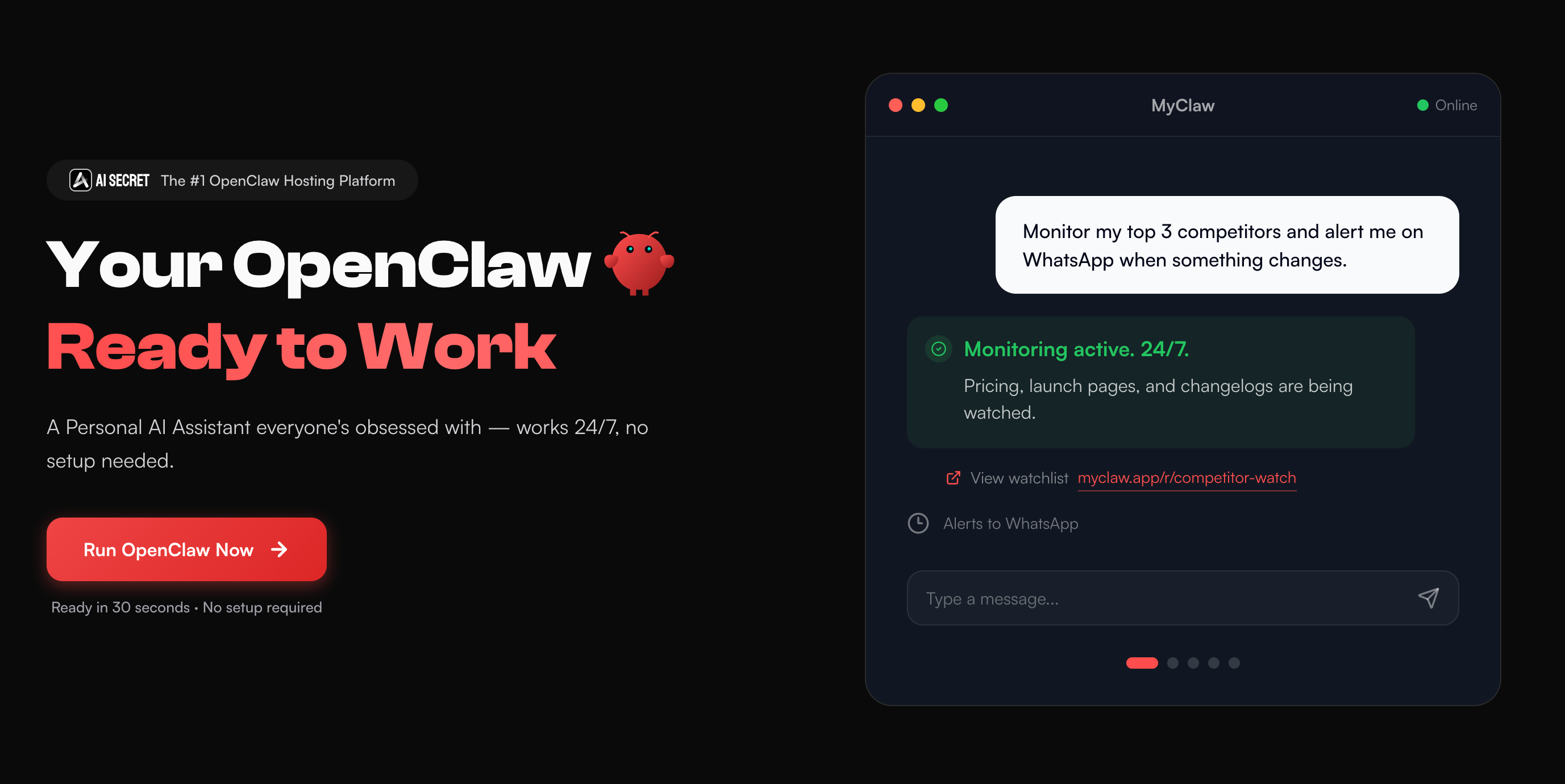 To compare models as agents, run them in the same environment. A one-off chat does not show how a model handles files, tools, browser state, recurring runs, or approvals.
MyClaw hosts OpenClaw agents in an always-on workspace where you can use Gemini 3.1 Pro and GPT-5.4 directly inside the agent. The comparison does not have to stay abstract. Give the agent the same files, tools, browser workflow, memory, and task instructions, then switch models and see which one gets the work done better.
This is the cleanest way to judge Gemini 3.1 Pro vs GPT-5.4 for real agent work. GPT-5.4 may be better at careful execution, while Gemini 3.1 Pro may handle broad context better. In MyClaw, both can be tested against the same practical workflow instead of separate chat sessions.
How to Use MyClaw for This Comparison
- Create one agent workflow. Use a real task such as PR review, research synthesis, SEO audit, or competitor monitoring.
- Run it with both models. Use GPT-5.4 once, then Gemini 3.1 Pro, while keeping the same files, tools, instructions, and approval rules.
- Compare the finished work. Look at accuracy, cleanup time, tool reliability, cost, and whether the agent can repeat the workflow without extra supervision.
The point is not to prove that one model wins every category. It is to build a workflow where models can be swapped, tested, and judged by the quality of completed work.
Conclusion
The Gemini 3.1 Pro vs GPT-5.4 decision comes down to the job. GPT-5.4 is the better first choice for thinking, coding, professional work, and careful agent execution. Gemini 3.1 Pro is a strong option for long-context, multimodal, Google-native, and agentic coding workflows.
If the task is a single answer, choose the model that fits the prompt. If the task is recurring work, judge the full system: model, tools, files, memory, runtime, approvals, and verification. That is where the difference between a smart chatbot and a useful AI agent becomes obvious.
Skip the Setup, Run Best-in-Class AI Agents Now
Launch a managed OpenClaw or Hermes Agent workspace in minutes, with always-on hosting, updates, and support handled by MyClaw.
Get Started