Grok 4.5
Grok 4.5 is xAI's smartest model for coding, agentic tasks, and knowledge work, released on July 8, 2026 with fast-model serving speed and competitive API pricing.
What Grok 4.5 Is Built For
xAI positions Grok 4.5 around real engineering work: coding, agentic rollouts, technical knowledge, and office workflows that need reliable execution.
Real-World Engineering Tasks
The official announcement emphasizes coding, science, engineering, and math data, plus benchmark gains on software engineering and terminal tasks.
Agentic Workflows
Grok 4.5 was reinforced on hundreds of thousands of multi-step tasks and is designed for long-running software engineering and technical agents.
Fast And Cost-Efficient Serving
xAI says Grok 4.5 runs at 80 tokens per second and uses about 4.2x fewer output tokens than Opus 4.8 max on SWE Bench Pro tasks.
Official Engineering Benchmark Signals
The xAI announcement reports Grok 4.5 on DeepSWE 1.0, DeepSWE 1.1, Terminal Bench 2.1, and SWE Bench Pro for engineering-heavy model selection.
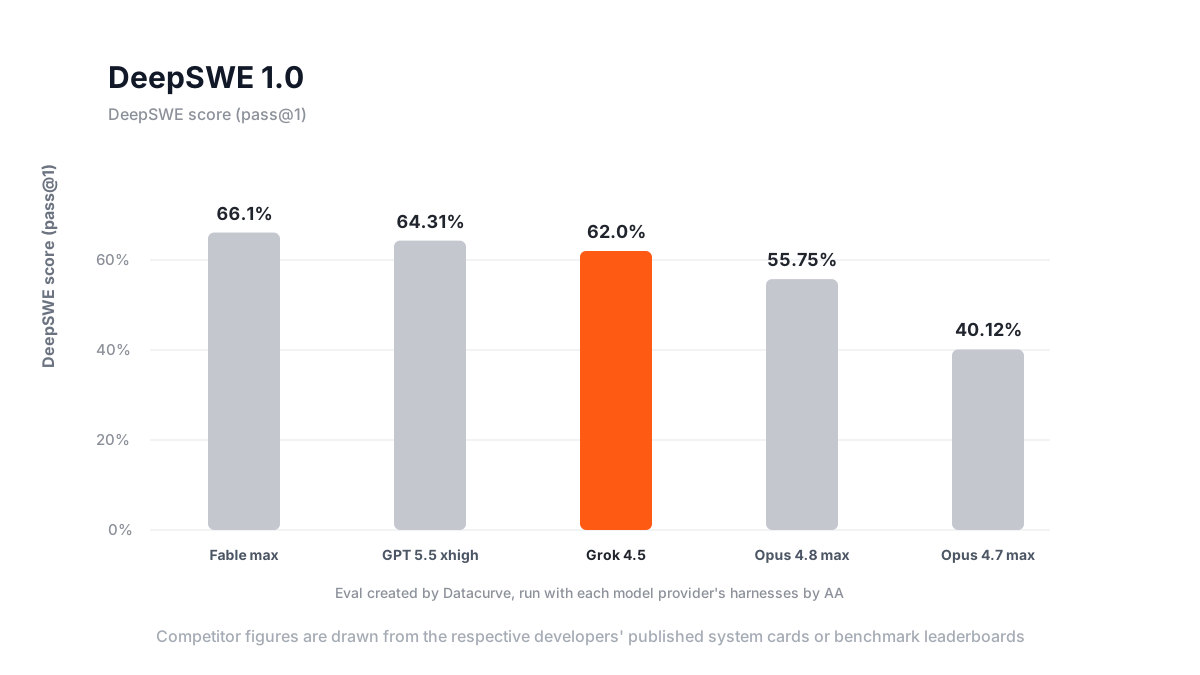
Use these published scores as selection signals, then validate Grok 4.5 against your own repositories, tool schemas, and latency targets before production use.
Grok 4.5 Vs Opus 4.8 Vs Fable 5 Vs Sonnet 5 Vs GPT 5.5
Use this table as a practical model-selection view for coding agents, terminal tasks, cost control, speed, and production rollout. Scores come from the same published materials where possible, and caveats are called out when a model is not in the same benchmark table.
| Decision Dimension | Grok 4.5 | Claude Opus 4.8 | Claude Fable 5 | Claude Sonnet 5 | GPT 5.5 |
|---|---|---|---|---|---|
| Best First Use | Fast coding agents, terminal execution, and cost-aware engineering work where 80 TPS and lower output-token use matter. | Difficult Opus-class coding, professional analysis, computer use, and cybersecurity workflows where higher capability is worth the price. | Hardest long-horizon agent work, ambitious Claude Code projects, research, vision, and sustained multi-step execution. | Everyday production agents, code search, patching, browsing, and tool workflows where cost-performance matters more than peak capability. | Strong general coding and reasoning baselines, especially when you already run OpenAI workflows and want an xhigh-effort comparison point. |
| Engineering Benchmark Signals | DeepSWE 1.0: 62.0%; DeepSWE 1.1: 53%; Terminal Bench 2.1: 83.3%; SWE Bench Pro: 64.7%. | DeepSWE 1.0: 55.75%; DeepSWE 1.1: 59%; Terminal Bench 2.1: 78.9%; SWE Bench Pro: 69.2%. | Fable max leads the xAI chart: DeepSWE 1.0: 66.1%; DeepSWE 1.1: 70%; Terminal Bench 2.1: 84.3%; SWE Bench Pro: 80.4%. | Anthropic system-card signals: SWE Bench Pro 63.2, Terminal Bench 2.1 80.4, FrontierCode v1 38.8 at max effort. | xAI chart reports GPT 5.5 xhigh at DeepSWE 1.0: 64.31%; DeepSWE 1.1: 67%; Terminal Bench 2.1: 83.4%; SWE Bench Pro: 58.6%. |
| Speed And Latency Posture | xAI lists 80 TPS and positions it as faster than flash models for engineering tasks. | Regular Opus mode prioritizes capability; Anthropic also lists a paid fast mode for higher-speed Opus usage. | Prioritizes peak capability and long-running focus more than lowest latency. | Better default for higher-throughput production agents when Opus or Fable capability is not required. | xhigh effort can be strong but should be tested against your latency budget; public xAI chart does not provide serving TPS. |
| API Cost Posture | $2 input and $6 output per 1M tokens in the xAI launch announcement. | $5 input and $25 output per 1M tokens for regular use; fast mode is listed higher. | Anthropic lists $10 input and $50 output per 1M tokens. | Introductory pricing was $2 input and $10 output per 1M tokens through August 31, 2026; standard pricing is $3 input and $15 output. | Verify current OpenAI pricing before production; the Grok 4.5 source compares benchmark scores, not GPT 5.5 pricing. |
| Agent Reliability Focus | Strong fit for multi-step technical work with lower output-token use and fast response loops. | Good when the agent must catch mistakes, ask clarifying questions, and handle complex computer-use or security work. | Best when the agent needs persistent focus across very complex tasks and many tool rounds. | Good default for structured production loops where reliability and budget both matter. | Useful as an OpenAI baseline, but compare on your exact tools, schemas, and failure modes before switching. |
| Safety And Guardrails | Use normal production safeguards and tool permissions; xAI source emphasizes engineering capability rather than detailed safety routing. | Anthropic positions Opus 4.8 as suitable for higher-capability work, including cybersecurity workflows requiring reduced guardrails. | Generally available with Fable-specific classifiers; selected sensitive requests may route away from Fable. | Lower dangerous cyber capability than Opus/Fable in Anthropic materials and a good safer default for many teams. | Follow OpenAI policy and your internal tool-permission controls; safety posture depends on the selected product surface and settings. |
| Availability And Rollout | Available in Grok Build, Cursor, and xAI API at launch; EU availability was expected in mid-July 2026. | Available across Claude API and Claude Code according to Anthropic launch materials. | Generally available through Claude API and supported cloud platforms, with model access depending on rollout and plan. | Available across Claude plans, Claude Code, and Claude Platform according to its launch materials. | Use the current OpenAI API or product surface available to your account; rollout details can vary by plan and region. |
| Choose This Model When | You want a fast, lower-cost first pass for coding agents and can validate quality on your own repo tasks. | The task is difficult enough that a stronger Opus-class model justifies more spend. | You need maximum agentic coding strength and sustained long-horizon reasoning more than low cost. | You need a reliable daily driver for agent workflows with a better cost-performance balance. | Your stack is OpenAI-centered or you need to benchmark against a strong GPT 5.5 xhigh reference. |
Grok 4.5, Opus 4.8, Fable max, and GPT 5.5 xhigh benchmark rows use the official xAI Grok 4.5 announcement chart where listed. Sonnet 5 data uses Anthropic Sonnet 5 materials already represented on this site. Always test on your own prompts, repos, tools, context length, latency target, and budget before production routing.
Where Grok 4.5 Fits In MyClaw
Grok 4.5 is a strong candidate when the task blends coding, tools, documents, and repeated execution inside one hosted agent workspace.
Coding Agents
Use Grok 4.5 for repository fixes, terminal task execution, and multi-step implementation workflows where speed and output-token efficiency matter.
Technical Research
Pair the model with files, browser-ready workflows, and structured notes when the task spans engineering, math, science, and knowledge work.
Office Automation
Test PowerPoint outlines, spreadsheet modeling, and Word drafting workflows that need planning plus concrete document operations.
Model Evaluation
Compare Grok 4.5 against Claude, GPT, Gemini, MiniMax, and Qwen models on your own benchmark prompts before switching workloads.
Use Grok 4.5 With Focused Agent Skills
Pair Grok 4.5 with MyClaw skills for coding, repo review, SEO research, session analysis, and team operations instead of prompting every workflow from scratch.
Coding Agent Skill
Use Grok 4.5 for repository fixes, implementation plans, terminal tasks, and verification steps inside a structured coding-agent workflow.
Open Coding SkillGitHub AgentGitHub Issues Skill
Turn GitHub issues into scoped implementation work, PR-ready changes, and review follow-ups while Grok 4.5 handles coding-heavy reasoning.
Open GitHub Issues SkillRepo ContextOracle Skill
Bundle prompts and relevant repo files into focused requests so Grok 4.5 can reason over cleaner context before an agent executes.
Open Oracle SkillSEO AgentWebsite SEO Skill
Use Grok 4.5 for technical page checks, content diagnostics, and prioritized SEO recommendations inside a repeatable audit skill.
Open Website SEO SkillAudit AgentSession Logs Skill
Review long-running agent history, extract decisions, and convert Grok 4.5 sessions into follow-up tasks your team can inspect.
Open Session Logs SkillTeam AgentSlack Skill
Connect Grok 4.5 output to team workflows by preparing updates, summaries, and replies for Slack-based operations.
Open Slack SkillCompare Grok 4.5 With Other Agent Models
Use these model pages to compare Grok 4.5 against Claude, OpenAI, and long-context agent models for coding, terminal work, speed, and production routing.
Grok 4.5 FAQs
Grok 4.5
Use Grok 4.5 In A Hosted MyClaw Agent
Start from a managed workspace, test Grok 4.5 on coding or knowledge-work tasks, and compare it with other frontier models using your real prompts.
Run Grok 4.5 in MyClaw